Last Updated: May 28, 2026 | By Yunenx Production Team
📧 Email: [email protected]
🔗 Connect on LinkedIn
🌐 Visit our website: www.yunenx.com
💬 Chat on WhatsApp
What is a custom sportswear manufacturer and how should buyers evaluate one?
What is a custom sportswear manufacturer?
A custom sportswear manufacturer is a production partner that develops and produces activewear, gym wear, teamwear, and fitness apparel according to a brand’s specifications, materials, sizing standards, and performance requirements.
As competition in activewear continues to grow, buyers are facing a common challenge: many suppliers can produce similar-looking products, but not all can deliver consistent quality, reliable lead times, and scalable production.
Whether you are an established sportswear brand, importer, wholesaler, retail chain buyer, distributor, promotional products company, or sports club, evaluating a manufacturer properly before placing an order can help avoid costly production mistakes later.
Quick Answer
A reliable custom sportswear manufacturer should offer suitable MOQ options, proven sampling procedures, stable fabric sourcing, quality control systems, realistic lead times, and experience with activewear production. Buyers should evaluate fabric performance, fit testing, communication efficiency, certifications, and production capability before placing bulk orders.
Key Takeaways
- Verify fabric composition such as 80% nylon / 20% elastane with 4-way stretch performance.
- Confirm UPF 50+, color fastness, compression level, and GSM weight before sampling.
- Review MOQ requirements together with fabric availability and customization options.
- Never skip fit testing before bulk production.
- Evaluate QC systems during production, not only final inspection.
- Confirm lead time based on fabric lead time and production capacity.
- Ask for OEKO-TEX, GRS, or SGS testing reports when applicable.
Why Manufacturer Evaluation Matters More Than Ever
According to Textile Exchange’s latest Material Market Report, brands continue increasing their use of recycled fibers and sustainable materials throughout apparel production.
At the same time, activewear buyers are demanding:
- Recycled fabrics
- Compression technology
- Functional textiles
- Eco-friendly packaging
- Faster replenishment cycles
Many sustainable sportswear brands now prefer ECONYL regenerated nylon and REPREVE recycled polyester because these materials align with Global Recycled Standard (GRS) requirements and broader sustainability initiatives promoted by Textile Exchange.
However, sustainability alone does not guarantee production success.
Fabric may look similar. Performance doesn’t.
10 Factors Buyers Should Review Before Ordering
1. MOQ Requirements
MOQ is often the first topic discussed.
A low MOQ sportswear manufacturer may appear attractive, but buyers should understand the trade-offs:
- Higher unit costs
- Limited fabric choices
- Fewer color options
- Reduced customization flexibility
MOQ misunderstanding is one of the most common sourcing problems we see.
2. Fabric Performance Specifications
Do not evaluate fabric by composition alone.
Confirm:
- Fabric composition
- GSM weight
- 4-way stretch
- Compression level
- Moisture management
- Color fastness
- Shrinkage tolerance
For performance activewear, fabrics between 220-320 GSM are commonly used depending on product category.
3. UPF 50+ Protection
For outdoor fitness brands, sports clubs, and promotional sportswear programs, UPF 50+ protection can be a key requirement.
Ask whether testing has been verified through SGS testing or equivalent laboratories.
4. Chlorine Resistance
Particularly important for swim teams and aquatic sports programs.
Chlorine-resistant fabrics can significantly improve garment lifespan in pool environments.
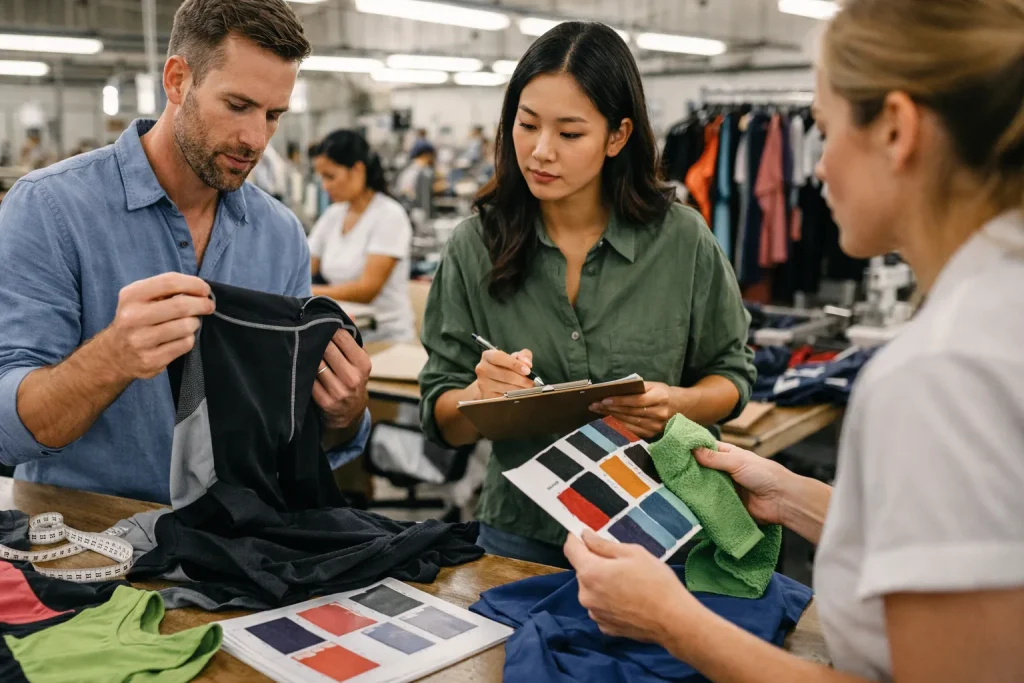
5. Sampling Capability
Sampling reveals more than product appearance.
It shows:
- Pattern development ability
- Sewing quality
- Technical understanding
- Communication efficiency
Cheap samples often become expensive bulk orders later.
Really.
6. Fit Testing Process
Many startups underestimate fitting revisions.
One sample round often turns into three.
We have seen buyers skip fit testing to save time. Usually that delay becomes more expensive during bulk production.
7. Seam Construction
Review sewing methods carefully.
Examples include:
- Flatlock stitching
- Coverstitch
- Reinforced seams
- Bonded construction
Seam quality directly affects durability and comfort.
8. Printing & Branding Methods
Evaluate available decoration methods such as:
- Sublimation printing
- Heat transfer
- Silicone logo application
- Screen printing
Ask how branding performs after repeated washing.
9. Quality Control System
QC inspection should happen throughout production.
Not only at the end.
A strong system typically includes:
- Fabric inspection
- Cutting inspection
- Inline sewing inspection
- Measurement verification
- Final inspection
10. Lead Time Reliability
Unrealistic lead time expectations create problems for both buyers and suppliers.
Lead time depends on:
- Fabric availability
- Sampling revisions
- Production schedule
- Shipping method
Fast promises are easy.
Consistent delivery is harder.
Factory Reality: What Buyers Often Miss
A fabric may pass lab testing but still curl badly during stitching if elastane stability is weak.
Some recycled fabrics perform well in testing but become difficult during mass production.
A perfect-looking sample does not automatically guarantee smooth bulk production.
These are factory realities rarely discussed during quotation stages.
Factory vs Trading Company Comparison
| Factor | Factory | Trading Company |
|---|---|---|
| Production Visibility | Direct | Limited |
| Technical Communication | Faster | Indirect |
| Sampling Revisions | Easier | Slower |
| MOQ Flexibility | Depends on capacity | Depends on factory network |
| Quality Control | Direct oversight | Third-party coordination |
| Risk of Miscommunication | Lower | Higher |
| Best For | Long-term brands | Multi-category sourcing |
Step-by-Step Procurement Guide
1. Material Selection
Confirm composition, GSM, stretch ratio, and performance requirements.
2. Tech Pack Confirmation
Verify measurements, construction details, and branding placement.
3. Lab Dip Approval
Approve colors before production.
Color inconsistency often begins here.
4. Sampling Stage
Review workmanship and overall appearance.
5. Fit Testing
Confirm sizing and wearer comfort.
6. Bulk Production
Approve PPS sample before production begins.
7. Quality Inspection
Monitor production at multiple checkpoints.
8. Shipping & Risk Control
Review packaging, shipping terms, and delivery schedule.
Common Buyer Mistakes
Skipping Sampling
Risk:
Incorrect fit and construction issues.
Cost Impact:
Bulk remake costs.
Ignoring Fabric Testing
Risk:
Shrinkage, pilling, color migration.
Cost Impact:
Customer complaints and returns.
No Size Spec Confirmation
Risk:
Measurement inconsistency.
Cost Impact:
High defect rates.
Unrealistic Lead Time Expectations
Risk:
Production delays.
Cost Impact:
Missed selling seasons.
Choosing Suppliers Only by Price
Risk:
Quality instability.
Cost Impact:
Long-term sourcing problems.
Buyer Checklist Before Bulk Production
Before issuing a purchase order, confirm:
- Fabric composition approved
- GSM confirmed
- Color approved
- PPS sample approved
- Size chart validated
- QC standard confirmed
- Packaging requirements approved
- Lead time aligned
- Shipping terms confirmed
- Branding details approved
Ready to Compare Sportswear Manufacturing Options?
Yunenx supports custom sportswear manufacturing, activewear OEM/ODM development, private label production, fabric sourcing, sampling, and bulk production management for growing brands, importers, distributors, retail chains, and sports organizations.
If you are comparing suppliers or reviewing production options, we are happy to discuss your project requirements and share practical manufacturing insights.
Conclusion
Choosing the right custom sportswear manufacturer involves far more than comparing quotations.
The most successful buyers evaluate MOQ, fabric performance, sampling capability, fit testing procedures, quality control systems, and lead time reliability before placing orders.
A manufacturer is not simply a supplier.
It is a long-term production partner.
FAQ
What is the typical MOQ for custom sportswear?
MOQ varies depending on fabric availability, product complexity, and customization requirements. Many manufacturers offer 100–300 pieces per style, while highly customized programs may require larger quantities.
How long does sportswear production take?
Typical lead time ranges from 30–60 days after sample approval. Fabric sourcing, seasonal demand, and production schedules can affect timing. Please contact us to confirm current lead times.
Do manufacturers support custom designs?
Yes. Most OEM and private label sportswear manufacturers support custom fabrics, colors, logos, labels, packaging, and garment construction based on approved tech packs.
What fabrics are commonly used in activewear?
Common options include nylon-spandex blends, polyester-spandex blends, ECONYL regenerated nylon, and REPREVE recycled polyester, depending on performance requirements and sustainability goals.
Are sustainable fabrics available?
Yes. Many manufacturers offer OEKO-TEX certified fabrics, GRS-certified recycled materials, ECONYL nylon, and REPREVE polyester for brands seeking sustainable product development.
Suggested Internal Links
- Custom Sportswear Manufacturing Services
- Activewear Fabric Library
- Sublimation Printing Guide
- Quality Control Inspection Process
Recommended External References
Explore more insights here:
https://yunenx.com/blog/
About the Author
Yunenx Sportswear Team is a professional manufacturer specializing in custom sportswear, swimwear, and teamwear for established brands, importers, wholesalers, and retail programs worldwide.
We support buyers through every stage of the sourcing process — from product development and fabric selection to sampling, production, and bulk manufacturing — ensuring consistent quality and reliable delivery for long-term supply partnerships.
If you are sourcing a dependable sportswear or swimwear manufacturer for your next collection or seasonal program, our team is ready to support your product development and production needs.
Feel free to contact us for quotations, technical discussion, or sample evaluation.