Last Updated: May 29, 2026 | By Yunenx Sales Team
📧 Email: [email protected]
🔗 Connect on LinkedIn
🌐 Visit our website: www.yunenx.com
💬 Chat on WhatsApp
What is sportswear manufacturer pricing and why do quotes vary so much?
What is sportswear manufacturer pricing? It is the total cost structure behind developing and producing sportswear products, including fabric sourcing, trims, printing, sampling, labor, quality control, packaging, and logistics.
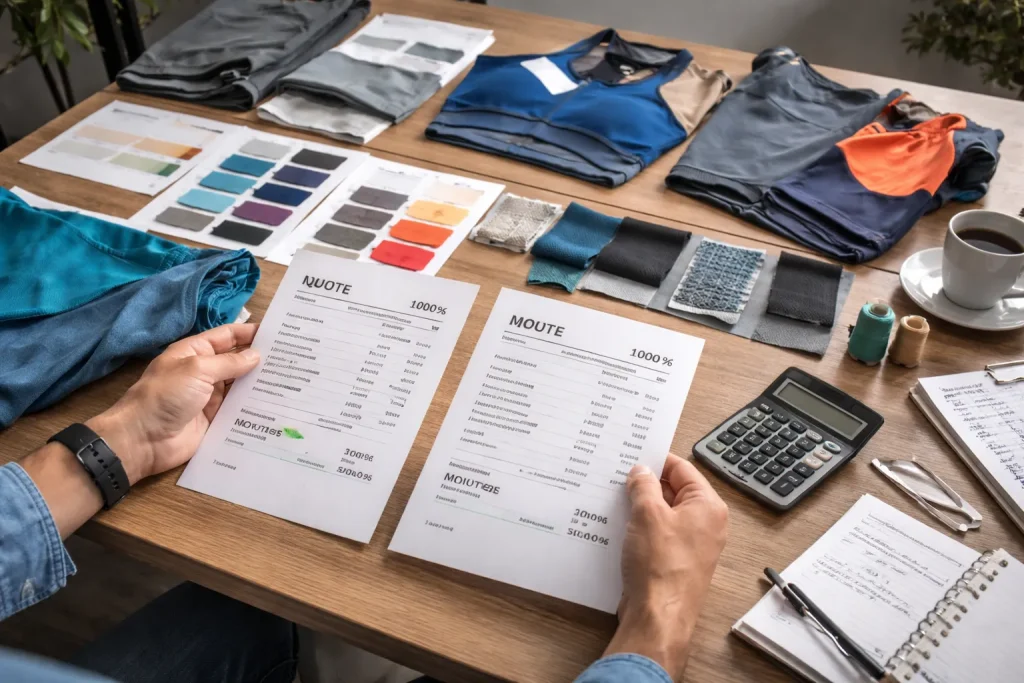
As more brands, importers, distributors, and retail buyers source from Asia, comparing sportswear quotes has become increasingly difficult. Two suppliers may quote the same activewear leggings or training shorts, yet prices can differ by 20–50%.
The challenge is that many buyers compare only the final price instead of comparing what is actually included in the quotation.
This guide explains how to compare sportswear quotes, MOQ requirements, fabrics, and lead times like an experienced buyer while avoiding costly sourcing mistakes.
Quick Answer
Sportswear manufacturer pricing depends on fabric composition, GSM weight, construction complexity, MOQ, printing methods, quality standards, and production lead times. When comparing sportswear quotes, buyers should evaluate fabric performance, sampling requirements, production capability, quality control processes, and delivery risks—not just unit price.
Key Takeaways
- Compare fabric composition, not just fabric appearance.
- Verify GSM weight, 4-way stretch performance, and color fastness.
- Confirm MOQ per color, per style, and total order quantity.
- Review lead times including fabric booking and lab dip approval.
- Check seam construction such as flatlock stitching and coverstitch.
- Evaluate UPF 50+ and chlorine resistance requirements when applicable.
- Always approve samples before bulk production.
- Low quotations often exclude testing, inspection, or development costs.
Why Sportswear Quotes Are Different Even for Similar Products
Many buyers assume a pair of activewear leggings is the same product across different suppliers.
In reality, it rarely is.
For example:
A supplier may quote using:
- 75% recycled nylon / 25% elastane
- 230 GSM
- Flatlock stitching
- SGS testing
- OEKO-TEX approved fabric
Another supplier may quote:
- 80% polyester / 20% elastane
- 180 GSM
- Standard overlock stitching
- No testing included
The products may look similar in photos but perform very differently during use.
Fabric may look similar. Performance doesn’t.
Industry Trends Affecting Sportswear Manufacturer Pricing
The sportswear market continues moving toward performance-driven and sustainable materials.
Major trends include:
1. Recycled Fabrics
Many brands now use recycled nylon and recycled polyester materials such as ECONYL and REPREVE to support sustainability goals.
According to Textile Exchange, the industry challenge aimed to increase recycled polyester adoption from 14% in 2019 to 45% by 2025, demonstrating strong market demand for recycled materials.
2. Functional Textiles
Growing demand exists for:
- UPF 50+
- Moisture management
- Chlorine resistance
- Compression technology
- Anti-odor finishes
3. Supply Chain Transparency
Certification systems such as OEKO-TEX and Global Recycled Standard (GRS) continue gaining importance among retailers and established brands. OEKO-TEX updated certification requirements in 2025 to strengthen traceability and compliance standards.
Key Factors Buyers Should Compare in Sportswear Quotes
Fabric Composition
Ask suppliers to specify:
- Nylon / Elastane ratio
- Polyester / Elastane ratio
- Recycled content percentage
- Fabric supplier source
Example:
- 75% Nylon / 25% Elastane
- 78% Recycled Nylon / 22% Elastane
- 87% Polyester / 13% Elastane
Different compositions create different performance outcomes.
GSM Weight
Typical ranges:
| Product | Common GSM |
|---|---|
| Running T-shirt | 140–180 GSM |
| Activewear Leggings | 220–300 GSM |
| Sports Bra | 240–320 GSM |
| Training Shorts | 120–180 GSM |
Lower GSM usually reduces cost but may affect opacity and durability.
Stretch & Compression
Confirm:
- 4-way stretch
- Stretch recovery
- Compression level
A fabric with poor recovery may pass initial inspection but lose shape after repeated wear.
Color Fastness
Request testing data for:
- Washing
- Perspiration
- Rubbing
- UV exposure
Seam Construction
Compare:
- Flatlock stitching
- Coverstitch
- Bonded seams
- Standard overlock
Seam type affects durability and production cost.
Factory vs Trading Company: What Buyers Should Compare
| Factor | Factory | Trading Company |
| Technical communication | Direct | Indirect |
| Development speed | Faster | Depends on factory |
| Cost transparency | Higher | Lower |
| Production control | Direct | Variable |
| Multiple category sourcing | Limited | Stronger |
| Sampling revisions | Easier | May take longer |
| Risk of information loss | Lower | Higher |
Neither option is automatically better.
It depends on project complexity and sourcing strategy.
Step-by-Step Guide to Comparing Sportswear Quotes
1. Material Selection
Confirm:
- Fabric composition
- GSM
- Stretch performance
- Certification requirements
2. Tech Pack Confirmation
Review:
- Measurements
- Construction details
- Printing locations
- Trim specifications
3. Lab Dip Approval
Approve colors before bulk production.
Color inconsistency remains one of the most common causes of disputes.
4. Sampling Stage
Never skip samples.
5. Fit Testing
Test actual garment fit.
We have seen buyers skip fit testing to save time.
Usually that delay becomes more expensive during bulk production.
6. Bulk Production
Confirm:
- Production schedule
- Material arrival dates
- Capacity allocation
7. Quality Inspection
Verify:
- Measurements
- Stitching quality
- Appearance defects
- Packaging
8. Shipping & Risk Control
Review:
- Transit time
- Customs requirements
- Packaging standards
- Delivery windows
Factory Reality: What Buyers Often Miss
Cheap samples often become expensive bulk orders later.
Some suppliers intentionally use different materials during sampling and production.
A fabric may pass laboratory testing but still perform poorly during stitching if elastane stability is weak.
This issue is more common than many buyers realize.
Many startups underestimate fitting revisions.
One sample round often turns into three.
That is normal.
Common Mistakes When Comparing Sportswear Quotes
Choosing Only by Price
Risk:
- Fabric substitution
- Lower durability
- Higher defect rates
Ignoring Fabric Testing
Risk:
- Claims
- Returns
- Retail compliance failures
Skipping Samples
Risk:
- Poor fit
- Production delays
- Costly rework
Misunderstanding MOQ
Risk:
- Unexpected costs
- Order rejection
Unrealistic Lead Time Expectations
Risk:
- Missed launch dates
- Air freight expenses
Speed matters.
Skipping validation usually costs more later.
Internal Resources
Learn more:
- Sportswear manufacturer
- Fabric Library: sportswear fabric guide
- Compression Fabric Guide
- Sportswear FAQ
Explore more insights here:
https://yunenx.com/blog/
For certification information:
- Textile Exchange: https://textileexchange.org
- OEKO-TEX: https://www.oeko-tex.com
Production Readiness Checklist
Before bulk production, confirm:
- Fabric composition approved
- GSM confirmed
- Lab dip approved
- Size chart approved
- Sample approved
- Fit testing completed
- Packaging requirements confirmed
- QC standards agreed
- Lead time aligned
- Shipping method confirmed
Ready to Compare Sportswear Quotes More Effectively?
Yunenx supports sportswear and swimwear brands with OEM and private label development, fabric sourcing, sample development, production management, and bulk manufacturing support.
Whether you are an established brand, importer, distributor, retailer, or startup, understanding the logic behind sportswear manufacturer pricing can significantly reduce sourcing risks and improve purchasing decisions.
Contact us if you would like a second opinion on supplier quotations, MOQ structures, or production planning.
Conclusion
Comparing sportswear manufacturer pricing is not about finding the lowest quote.
It is about understanding what is included behind the quote.
When evaluating sportswear quotes, buyers should compare fabric composition, GSM weight, 4-way stretch performance, compression level, color fastness, seam construction, MOQ requirements, and lead times together.
The most expensive quotation is not always overpriced.
The cheapest quotation is not always cheaper.
The best sourcing decisions come from understanding the production realities behind the numbers.
FAQ
How should I compare sportswear quotes from different manufacturers?
Compare fabric composition, GSM, seam construction, MOQ, testing requirements, sampling processes, and lead times. Do not compare unit prices alone because different suppliers may be quoting different product specifications.
What affects sportswear manufacturer pricing the most?
The biggest factors are fabric composition, fabric weight, printing method, construction complexity, MOQ, certification requirements, and labor costs. Performance fabrics generally increase production costs.
Is a lower MOQ always better?
Not necessarily. Lower MOQ production offers flexibility but often increases per-unit costs. Buyers should balance inventory risk against production efficiency.
Why do some suppliers offer much lower prices?
Lower prices may result from lighter fabrics, reduced quality control, simplified construction, or excluded testing services. Buyers should verify specifications before comparing costs.
How important is sampling before bulk production?
Sampling is critical. It helps identify fitting, construction, fabric, and color issues before production starts. Skipping samples often creates higher costs later.
About the Author
Yunenx Sportswear Team is a professional manufacturer specializing in custom sportswear, swimwear, and teamwear for established brands, importers, wholesalers, and retail programs worldwide.
We support buyers through every stage of the sourcing process — from product development and fabric selection to sampling, production, and bulk manufacturing — ensuring consistent quality and reliable delivery for long-term supply partnerships.
If you are sourcing a dependable sportswear or swimwear manufacturer for your next collection or seasonal program, our team is ready to support your product development and production needs.
Feel free to contact us for quotations, technical discussion, or sample evaluation.