Last Updated: September 28, 2026 | By Yunenx Sales Team
📧 Email: [email protected]
🔗 Connect on LinkedIn
🌐 Visit our website: www.yunenx.com
💬 Chat on WhatsApp
Finding the right activewear manufacturer in China can be challenging, especially when you are comparing factories, suppliers, sourcing companies and different production capabilities.
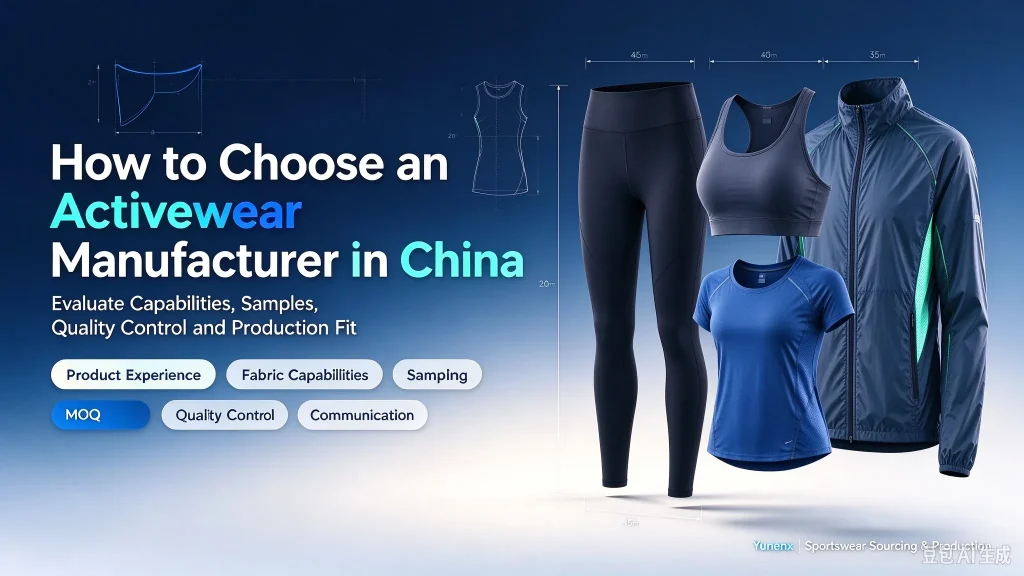
The right partner depends on more than price. You need to consider product experience, fabric capabilities, customization, MOQ, sample development, quality control, production capacity and communication.
Yunenx is a sportswear sourcing and production company working with selected long-term manufacturing partners in China. We support sportswear brands, activewear brands, wholesalers and distributors with product development, sourcing, sampling, production follow-up and shipping coordination.
This guide explains what to look for when comparing activewear manufacturers in China and how to prepare for your first production project.
What Is an Activewear Manufacturer?
An activewear manufacturer is a company involved in producing performance-oriented apparel such as leggings, sports bras, training tops, shorts, jackets and other fitness or athletic clothing.
Depending on the company, its capabilities may include:
- Cut-and-sew production
- Fabric sourcing
- Pattern development
- Sampling
- Sublimation printing
- Heat transfer and other decoration methods
- Private-label production
- OEM production
- ODM development
- Quality control
- Packaging and export
However, the term “manufacturer” can describe different business models.
Some companies operate their own factories. Others are trading or sourcing companies that work with manufacturing partners.
When comparing suppliers, it is therefore useful to understand who actually produces your garments, who manages production and who is responsible for quality control.
Activewear Manufacturers in China: What Can They Produce?
China has a broad apparel supply chain, so different manufacturers may specialize in different types of activewear.
Before contacting a supplier, identify the products you actually need.
Leggings and Yoga Pants
Common activewear products include:
- High-waisted leggings
- Training leggings
- Yoga pants
- Cycling shorts
- Flared yoga pants
- Performance tights
- Compression bottoms
Important specifications may include fabric stretch, recovery, opacity, waistband construction, fit and finishing.
Sports Bras and Training Tops
Sports bras and performance tops can require more detailed development because fit, support and construction are important.
Depending on the product, buyers may need to specify:
- Support level
- Cup construction
- Back design
- Elastic width
- Padding
- Fabric stretch
- Lining
- Strap construction
A supplier experienced with activewear should be able to discuss these requirements before sampling.
T-Shirts and Performance Tops
Activewear collections may also include:
- Performance T-shirts
- Tank tops
- Long-sleeve tops
- Crop tops
- Running tops
- Training shirts
- Lightweight jackets
The appropriate fabric depends on the intended activity, target market, design and price range.
Shorts and Bottoms
Common products include:
- Training shorts
- Running shorts
- Cycling shorts
- Gym shorts
- Basketball-style shorts
- Performance pants
Construction details such as pockets, waistbands, drawcords and lining should be confirmed before sampling.
Activewear Sets
Many brands develop coordinated collections rather than individual products.
For example:
- Sports bra + leggings
- Crop top + cycling shorts
- Tank top + leggings
- T-shirt + training shorts
- Jacket + leggings
Producing coordinated products can require consistent fabric color, stretch, fit and finishing across several styles.
What Is the Difference Between Activewear Manufacturer, Supplier and Sourcing Company?
These terms are often used interchangeably online, but they can describe different roles.
Activewear Manufacturer
A manufacturer is directly involved in garment production.
Some manufacturers own production facilities, while others may operate through a group of production facilities.
If owning a factory is important to you, ask for the actual production location and clarify which products are made there.
Activewear Supplier
“Supplier” is a broader term.
A supplier may be:
- A factory
- A manufacturer
- A trading company
- A sourcing company
- A production management company
Therefore, the word “supplier” alone does not tell you who manufactures the garments.
Activewear Sourcing Company
A sourcing company helps buyers find and coordinate suitable production resources.
Yunenx operates in this type of model. We work with selected long-term manufacturing partners in China and coordinate product development, sampling, production follow-up and quality control according to each project’s requirements.
For a broader explanation of custom production, see our guide to custom sportswear manufacturing.
How to Find Activewear Manufacturers in China
There are several ways to find potential activewear suppliers.
Google Search
Google can be useful for finding manufacturers through searches such as:
- Activewear manufacturers in China
- Activewear manufacturer China
- Fitness apparel manufacturers
- Activewear clothing manufacturers
- Private-label activewear manufacturer
- Custom activewear manufacturers
However, ranking highly on Google does not automatically mean that a supplier is suitable for your project.
Use search results to build an initial shortlist, then evaluate the actual company and production capabilities.
B2B Platforms
B2B marketplaces can provide access to a large number of suppliers.
They can be useful for comparing:
- Product categories
- MOQ
- Prices
- Factory locations
- Certifications
- Product photos
However, information on marketplace profiles should be verified directly with the supplier before making a production decision.
Trade Shows
Trade shows can be useful when you want to meet suppliers face to face and examine fabrics and samples.
They also allow buyers to compare different suppliers within a short period.
Referrals and Industry Contacts
Recommendations from other brands, sourcing professionals or industry contacts can also help identify potential suppliers.
Regardless of how you find a supplier, the same basic verification process should follow.
How to Evaluate an Activewear Manufacturer in China
Once you have a shortlist, compare suppliers using criteria that are relevant to your product.
1. Product Experience
Look for experience with the specific products you want to develop.
A supplier producing basic T-shirts may not have the same experience with:
- Sports bras
- Compression leggings
- Seamless activewear
- Technical performance garments
- Complex stretch fabrics
Ask to see relevant samples rather than relying only on a general product catalogue.
2. Fabric Capabilities
Fabric is one of the most important parts of activewear development.
Depending on the product, you may need fabrics with:
- High stretch
- Good recovery
- Moisture management
- Breathability
- Abrasion resistance
- Soft hand feel
- Shape retention
- UV resistance
- Recycled fiber content
Ask the supplier what fabrics they commonly use and whether they can work with your nominated fabric mill if you already have a preferred material.
3. Sampling Capability
Do not evaluate an activewear supplier only from photographs.
A physical sample allows you to check:
- Fit
- Fabric
- Stretch
- Recovery
- Construction
- Stitching
- Color
- Printing
- Logo placement
- Overall workmanship
If the first sample is not correct, ask how revisions are handled before moving to bulk production.
4. MOQ
MOQ can vary significantly between activewear manufacturers.
Some suppliers publish minimums of around 100–300 pieces for certain products, while others require larger quantities depending on the style, color or production method. Current supplier disclosures show considerable variation, so the exact MOQ should always be confirmed for your specific project.
Ask specifically:
- MOQ per style?
- MOQ per color?
- Can different sizes be mixed?
- Can different colors be combined?
- Does custom fabric have a separate MOQ?
- Is there a different MOQ for private label?
Do not compare suppliers based on one headline MOQ without checking these details.
5. Customization
If you are developing your own activewear collection, confirm what can actually be customized.
Possible options include:
- Custom colors
- Custom patterns
- Custom labels
- Woven labels
- Hangtags
- Packaging
- Logo application
- Custom size charts
- Custom fabric
- Custom trims
For a new brand, it is often more important to find a supplier that can reliably handle your actual requirements than simply finding the lowest quoted price.
6. Quality Control
Ask how quality is checked during production.
Important areas can include:
- Measurements
- Fabric quality
- Color consistency
- Stitching
- Seam strength
- Printing
- Logo placement
- Garment appearance
- Quantity
- Packing
You should also clarify who performs the inspection and how problems are handled if the finished goods do not meet the approved specifications.
7. Production Capacity
Capacity matters particularly when your order volume is expected to increase.
Ask about:
- Typical monthly production
- Number of production lines
- Product specialization
- Peak-season capacity
- Sample capacity
- Production lead time
Do not automatically assume that a larger factory is better for every project.
A smaller production setup may be suitable for a smaller brand, while a large recurring program may require greater capacity.
8. Communication
Good communication is especially important for activewear because specifications can be detailed.
Your supplier needs to understand:
- Tech packs
- Size charts
- Measurements
- Fabric specifications
- Artwork
- Construction details
- Packaging
- Delivery requirements
A supplier who communicates clearly during sampling is easier to work with when production becomes more complicated.
Activewear OEM, ODM and Private Label: What’s the Difference?
You may see OEM, ODM and private-label terms when researching activewear manufacturers in China.
OEM Activewear
OEM generally means the buyer provides the design or product specifications and the manufacturer produces the product according to those requirements.
The buyer may provide:
- Tech pack
- Measurements
- Fabric specifications
- Artwork
- Logo
- Packaging requirements
ODM Activewear
ODM generally involves greater support from the supplier in product development.
The supplier may help with:
- Product design
- Patterns
- Fabrics
- Construction
- Sample development
This can be useful for brands that have a product concept but do not have a complete technical package.
Private-Label Activewear
Private-label production means the products are sold under the buyer’s own brand.
A private-label project may involve:
- Custom labels
- Hangtags
- Packaging
- Brand colors
- Custom products
- Custom artwork
If you are planning a private-label sportswear collection, you can also see our private-label sportswear manufacturer guide.
For brands specifically interested in activewear OEM/ODM development, see our activewear OEM and ODM services.
What Certifications Should You Check?
Certifications can be useful, but buyers should understand exactly what a certificate covers.
Depending on the project, you may encounter standards or certifications related to:
- Social compliance
- Environmental management
- Recycled materials
- Chemical safety
- Product safety
For example, OEKO-TEX STANDARD 100 relates to testing textiles for harmful substances, while GRS is associated with recycled materials and chain-of-custody requirements.
Do not assume that a supplier mentioning a certification automatically means every product or every production facility is covered.
Ask for the relevant certificate and check:
- Certificate holder
- Certificate number
- Issuing organization
- Validity period
- Covered facility
- Covered products or materials
This is particularly important because activewear manufacturer websites can present certifications at different levels, including garment factories, fabric suppliers or material suppliers. Recent industry comparisons also highlight the importance of checking whether certification claims actually belong to the production facility or a partner mill.
What Should You Ask an Activewear Manufacturer Before Ordering?
Before requesting a quotation, prepare a simple list of questions.
Product
- What activewear products do you specialize in?
- Can you produce my reference design?
- Can you work with my tech pack?
- Can you develop patterns?
Fabric
- What fabrics are available?
- Can you provide fabric swatches?
- What are the fabric compositions?
- Can you use nominated fabrics?
- What is the fabric MOQ?
Sampling
- What is the sample cost?
- How long does sampling take?
- How many revisions are included?
- Can I approve a physical sample before bulk production?
Production
- What is the MOQ?
- What is the bulk production lead time?
- Can different sizes be mixed?
- Can different colors be combined?
- How is quality controlled?
Branding
- Can you make custom labels?
- Can you provide hangtags?
- Can you customize packaging?
- What logo application methods are available?
Shipping
- Which shipping methods are available?
- Can you arrange door-to-door delivery?
- What information is included in the shipping quotation?
The more complete your initial information, the easier it is for a supplier to provide a meaningful quotation.
What Information Should You Send for an Activewear Quote?
If you want an accurate quotation, prepare the following information:
- Product type
- Reference images
- Tech pack, if available
- Fabric preference
- Fabric composition
- Colors
- Logo
- Size chart
- Estimated quantity
- Quantity by color
- Quantity by size
- Label requirements
- Packaging requirements
- Delivery country
- Target delivery date
You do not need to have everything finalized before contacting a supplier.
If you are still developing the product, you can send a reference image and explain what you want to achieve. The supplier can then tell you which additional information is needed for sampling.
How Much Does Custom Activewear Manufacturing Cost?
There is no single price for custom activewear.
The final cost can depend on:
- Product type
- Fabric
- Fabric weight
- Construction
- Number of panels
- Printing
- Embroidery
- Trims
- Labels
- Packaging
- Quantity
- Sampling requirements
- Shipping method
For example, a simple performance T-shirt and a technical sports bra may have very different production costs even when the order quantity is similar.
When comparing quotations, make sure the specifications are the same.
A lower unit price may exclude certain elements such as custom packaging, nominated fabrics, labels or shipping.
For more information about the factors that influence sportswear pricing, see our sportswear manufacturer pricing guide.
Activewear Manufacturer vs. Factory: What Should Buyers Check?
A common mistake is to assume that every company calling itself a manufacturer owns the factory where your garments will be produced.
If factory ownership is important to your purchasing decision, ask directly:
- Where will my products be manufactured?
- Is the facility owned or operated by your company?
- Which company name appears on the production documents?
- Can you provide the factory address?
- Who is responsible for production quality?
- Can the production facility be audited or visited?
These questions are particularly important when working with sourcing companies or production management companies.
A sourcing partner can still be useful even when it does not own a factory, provided its role and responsibilities are clearly explained.
Working With Yunenx
Yunenx is a sportswear sourcing and production company working with selected long-term manufacturing partners in China.
We support buyers who need more than a factory contact but do not necessarily want to manage multiple suppliers themselves.
Our role can include:
- Product development
- Fabric sourcing
- Supplier matching
- Sample coordination
- Production follow-up
- Quality control coordination
- Packaging
- Shipping coordination
We work with different types of buyers, including:
- Sportswear brands
- Activewear brands
- Wholesalers
- Importers
- Distributors
- Retail businesses
Our approach is based on matching the project with suitable production resources rather than using one factory for every product.
If you are also developing other sportswear categories, our custom sportswear manufacturer guide explains how custom sportswear production works from development through bulk production.
Activewear Production for Long-Term Brands
For an activewear brand, the first sample or first order is only one stage of the relationship.
As your collection develops, you may need:
- Additional colors
- New styles
- Updated fabrics
- Seasonal collections
- Reorders
- New size ranges
- New packaging
- Additional products
A production partner should therefore be able to maintain consistent specifications across repeat orders.
For example, important information such as approved fabric, measurements, construction details, labels and packaging should be kept consistent unless the buyer requests a change.
This becomes particularly important when an activewear brand moves from small trial orders into regular production.
Frequently Asked Questions
What is the MOQ for activewear manufacturers in China?
MOQ varies by supplier, product, fabric, color and customization. Many suppliers publish MOQs around 100–300 pieces for certain activewear projects, while some products or fabrics require higher quantities. Always confirm the MOQ for your exact style and color.
Can activewear manufacturers produce custom designs?
Yes. Custom activewear can include custom colors, patterns, fabrics, logos, labels, packaging and product construction, depending on the supplier’s capabilities.
Can I order a sample before placing a bulk order?
Yes. Sample development is a normal part of custom activewear production. The sample allows you to check fit, fabric, construction, colors and customization before bulk production.
Can I use my own fabric?
Some suppliers can work with nominated fabrics or fabric mills. This should be confirmed before sampling because nominated fabrics may have their own MOQ and production requirements.
Can activewear manufacturers make private-label products?
Yes. Private-label activewear can include custom labels, hangtags, packaging and other branding requirements.
What is the difference between OEM and ODM activewear?
OEM generally means producing according to the buyer’s specifications, while ODM usually involves more product development support from the supplier.
How do I choose between an activewear factory and a sourcing company?
Consider how much support you need.
If you already have a complete technical package and want to manage the factory relationship directly, a factory may be suitable.
If you need help with supplier matching, fabric sourcing, sampling, production follow-up and coordination, a sourcing or production partner may be more suitable.
Can Yunenx help with activewear production in China?
Yes. Yunenx can support activewear product development, sourcing, sampling, production follow-up and quality control coordination through selected long-term manufacturing partners in China.
Request an Activewear Manufacturing Quote
If you are looking for an activewear manufacturer or production partner in China, send us your product requirements.
Please include:
- Product or reference image
- Estimated quantity
- Fabric requirements, if known
- Size information
- Branding requirements
- Delivery country
- Target delivery date
We will review the project and let you know what information is needed for quotation and sample development.
Quanzhou Yunenx Fashion Co., Ltd.
Sportswear sourcing and production for activewear, sportswear, swimwear and football teamwear.