
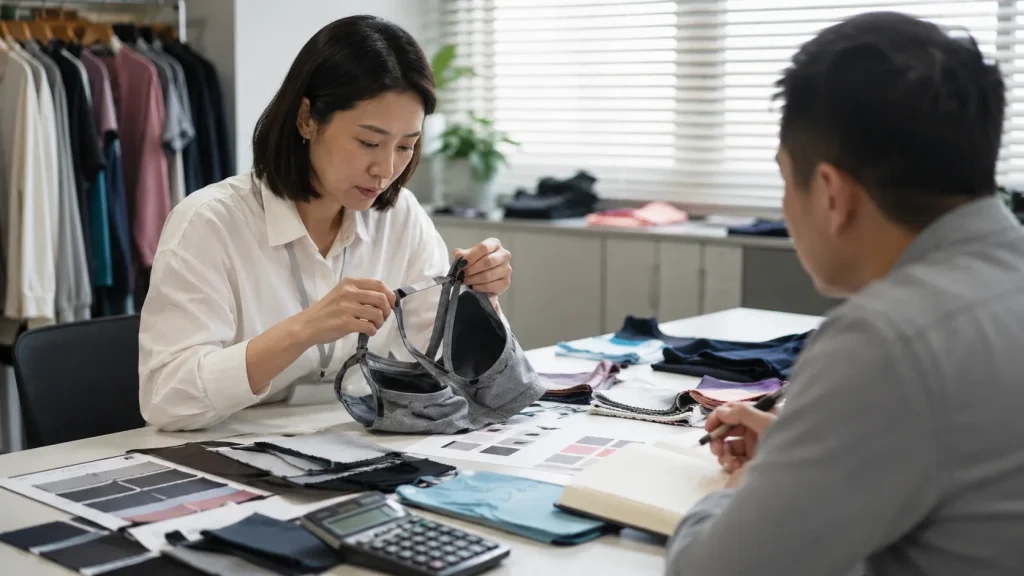
Last Updated: July 2, 2026 | By Yunenx Sales Team
📧 Email: [email protected]
🔗 Connect on LinkedIn
🌐 Visit our website: www.yunenx.com
💬 Chat on WhatsApp
Two manufacturers can quote exactly the same price.
One delivers products that arrive on shelves on time.
The other causes delayed launches, repeated sample revisions, and unexpected quality claims.
For retail buyers, choosing a manufacturer is rarely about finding the lowest quotation anymore. It’s about reducing uncertainty throughout the entire sourcing process.
After working with global sportswear and swimwear brands for more than 20 years, we’ve noticed that successful buyers evaluate suppliers very differently from first-time importers.
Key Takeaways
- Retail buyers expect manufacturers to solve problems—not simply produce garments.
- Fast, accurate sampling often matters more than the lowest unit price.
- Clear communication reduces sourcing risks far more than frequent promises.
- Reliable production planning is one of the biggest competitive advantages.
- Experienced factories help buyers avoid costly design and production mistakes before mass production begins.
What Buyers Actually Evaluate Before Placing an Order
Many suppliers believe buyers compare only prices.
In reality, experienced retail buyers usually evaluate suppliers across several dimensions.
| Buyer’s Expectation | Why It Matters | Risk if Missing |
|---|---|---|
| Accurate sample development | Confirms product feasibility | Endless sample revisions |
| Reliable lead time | Protects seasonal launches | Missed selling season |
| Consistent quality | Reduces customer returns | Brand reputation damage |
| Transparent communication | Faster decisions | Production misunderstandings |
| Flexible problem solving | Handles unexpected issues | Cost overruns |
The manufacturer becomes part of the buyer’s supply chain—not just a production vendor.
The Lowest Quote Often Creates the Highest Cost
One situation we’ve seen many times involves buyers collecting quotations from five or six factories.
Several suppliers immediately lower prices to win the order.
However, once sampling starts, additional charges begin appearing:
- Fabric substitutions
- Pattern modification fees
- Printing adjustments
- Packaging changes
- Shipping delays
Eventually, the “lowest price” supplier becomes the most expensive project.
From our experience, professional buyers usually ask detailed questions before discussing price because they know execution determines total sourcing cost.
When Better Communication Saved an Entire Collection
Background
A growing activewear brand planned to launch a new seasonal collection with six new styles.
Challenge
The original factory accepted every design without raising concerns.
After the first samples arrived, several fit issues appeared:
- Leggings became see-through during stretching.
- Sports bras lacked sufficient support.
- Two fabrics reacted differently after washing.
The development timeline quickly fell behind schedule.
Solution
During the second development round, the buyer worked with a manufacturer that reviewed every technical package before sampling.
Several recommendations were made:
- Increase fabric weight for leggings.
- Adjust compression panels.
- Improve seam placement.
- Recommend a more suitable elastic construction.
Result
Only one additional sample round was needed before bulk approval.
The collection launched on schedule without delaying retail delivery.
Lesson Learned
Experienced manufacturers identify production risks before they become expensive problems.
Buyers Appreciate Honest Answers More Than Perfect Answers
Many suppliers believe saying “Yes” helps secure orders.
In reality, experienced buyers often trust factories that explain limitations early.
For example, we’ve occasionally advised customers that:
- Their requested MOQ was unrealistic for a particular fabric.
- A specific print method wouldn’t achieve the desired color.
- Certain construction details would affect durability.
- Requested delivery dates carried unnecessary risks.
Although these conversations sometimes delayed initial decisions, they often strengthened long-term partnerships because expectations remained realistic from the beginning.
How Professional Buyers Select Manufacturers
Supplier Search
        ↓
Capability Evaluation
        ↓
Sample Development
        ↓
Technical Review
        ↓
Small Trial Order
        ↓
Bulk Production
        ↓
Quality Inspection
        ↓
Long-term Partnership
Each stage reduces sourcing risk before increasing purchasing volume.
Fast Sampling Isn’t About Speed Alone
Some factories advertise seven-day samples.
But speed means little if every sample requires three additional revisions.
We’ve found that retail buyers value sample accuracy much more than sample speed.
A technically correct sample saves weeks during development and prevents delays before production.
What Strong Manufacturers Usually Provide Beyond Production
Experienced apparel manufacturers often contribute value in areas buyers may not initially expect.
These include:
- Fabric recommendations based on performance requirements.
- Construction improvements for better durability.
- Cost optimization without reducing product quality.
- Packaging suggestions for retail presentation.
- Production scheduling advice for seasonal launches.
These services help buyers reduce sourcing risks while improving overall efficiency.
Helpful Resources for Retail Buyers
If you’re evaluating apparel manufacturers, these articles may also help:
- How to Reduce Sourcing Risks When Manufacturing Clothing in China
- OEM vs ODM Sportswear Production: A Buyer’s Decision Guide
- How Retail Chains Evaluate Suppliers
- How Wholesalers Reduce Inventory Risk in Global Sourcing
For industry standards and sourcing best practices, you may also find these resources useful:
- AATCC (American Association of Textile Chemists and Colorists)
- ASTM International Textile Standards
- OEKO-TEX® Standard 100
- Amfori BSCI
FAQ
Do retail buyers always choose the lowest-priced manufacturer?
No. Most experienced buyers evaluate the total sourcing cost, including quality, communication, lead time, and reliability.
What matters most during sampling?
Accurate pattern making, suitable fabric selection, and clear technical communication usually have the greatest impact on project success.
Why do experienced buyers ask so many technical questions?
Because identifying production risks before bulk manufacturing saves both time and money later.
Can a smaller manufacturer work with retail brands?
Yes. If the manufacturer has strong development capabilities, transparent communication, and consistent quality control, many retail buyers prefer working with smaller, more responsive partners.
Final Thought
Retail buyers aren’t simply looking for factories that can manufacture garments.
They’re looking for manufacturing partners who can anticipate problems, communicate honestly, and keep projects moving from concept to delivery.
After more than two decades in apparel sourcing and product development, we’ve learned that successful partnerships are rarely built on the lowest quotation—they’re built on consistent execution, realistic expectations, and shared commitment to delivering quality products on time.
About the Author
Yunenx Sportswear Team is a professional manufacturer specializing in custom sportswear, swimwear, and teamwear for established brands, importers, wholesalers, and retail programs worldwide.
We support buyers through every stage of the sourcing process — from product development and fabric selection to sampling, production, and bulk manufacturing — ensuring consistent quality and reliable delivery for long-term supply partnerships.
If you are sourcing a dependable sportswear or swimwear manufacturer for your next collection or seasonal program, our team is ready to support your product development and production needs.
Feel free to contact us for quotations, technical discussion, or sample evaluation.