Last Updated: June 4, 2026 | By Yunenx Sales Team
📧 Email: [email protected]
🔗 Connect on LinkedIn
🌐 Visit our website: www.yunenx.com
💬 Chat on WhatsApp
What is sourcing risk in China?
What is sourcing risk in China? It refers to the potential problems buyers may face during supplier selection, sampling, production, quality control, and shipment. As global brands continue to diversify their supply chains, China remains one of the world’s most important manufacturing hubs for sportswear, activewear, swimwear, fitness apparel, and private label production.
However, many buyers still experience delays, quality issues, unexpected costs, or communication gaps that affect profitability.
If you are sourcing from a sportswear manufacturer, activewear supplier China, or OEM production partner for the first time—or even if you already have sourcing experience—understanding how buyers reduce sourcing risks in China can save significant time, money, and operational headaches.
Quick Answer
The most effective way buyers reduce sourcing risks in China is by verifying supplier capabilities before sampling, testing fabrics before bulk production, confirming production specifications in writing, conducting pre-production approvals, and implementing independent quality inspections. Most sourcing failures occur not during manufacturing but during supplier selection, material approval, and communication stages.
Why Sourcing Risks Still Exist Despite China’s Manufacturing Strength
China remains the world’s largest apparel manufacturing ecosystem, supported by mature supply chains, fabric innovation, and specialized production clusters.
According to the latest data from the National Bureau of Statistics of China, the country’s textile and apparel industry continues to maintain one of the world’s largest manufacturing capacities.
At the same time, sourcing complexity has increased because:
- Buyers demand lower MOQs
- Product customization has become more complex
- Sustainability requirements continue to rise
- Lead times are becoming tighter
- Brands expect faster product launches
As a result, sourcing risk is no longer only about production quality. It now includes supplier reliability, compliance, material consistency, and project management.
The Five Biggest Risks Buyers Face When Sourcing in China
1. Supplier Capability Mismatch
Many suppliers can produce samples.
Far fewer suppliers can consistently execute bulk production.
A common mistake is selecting a supplier based solely on:
- Website appearance
- Sample quality
- Price quotation
Instead, buyers should verify:
- Production capacity
- Product specialization
- Export experience
- Quality control systems
- Fabric sourcing network
For example, a supplier experienced in fashion apparel may struggle with compression sportswear requiring precise GSM control, recovery testing, and flatlock stitching.
2. Fabric Performance Problems
Fabric issues are among the most expensive sourcing mistakes.
Key parameters buyers should verify include:
| Performance Factor | Recommended Verification |
|---|---|
| GSM | Lab test report |
| 4-Way Stretch | Stretch recovery test |
| Color Fastness | Wash and rub testing |
| Shrinkage | Pre-production fabric test |
| Chlorine Resistance | Swimwear performance testing |
| UPF 50+ | UV protection certification |
Fabric may look identical.
Performance rarely is.
We often see two fabrics with nearly the same appearance produce significantly different results after washing, stretching, or sublimation printing.
3. Bulk Production Differs From Approved Samples
This is one of the most common buyer complaints.
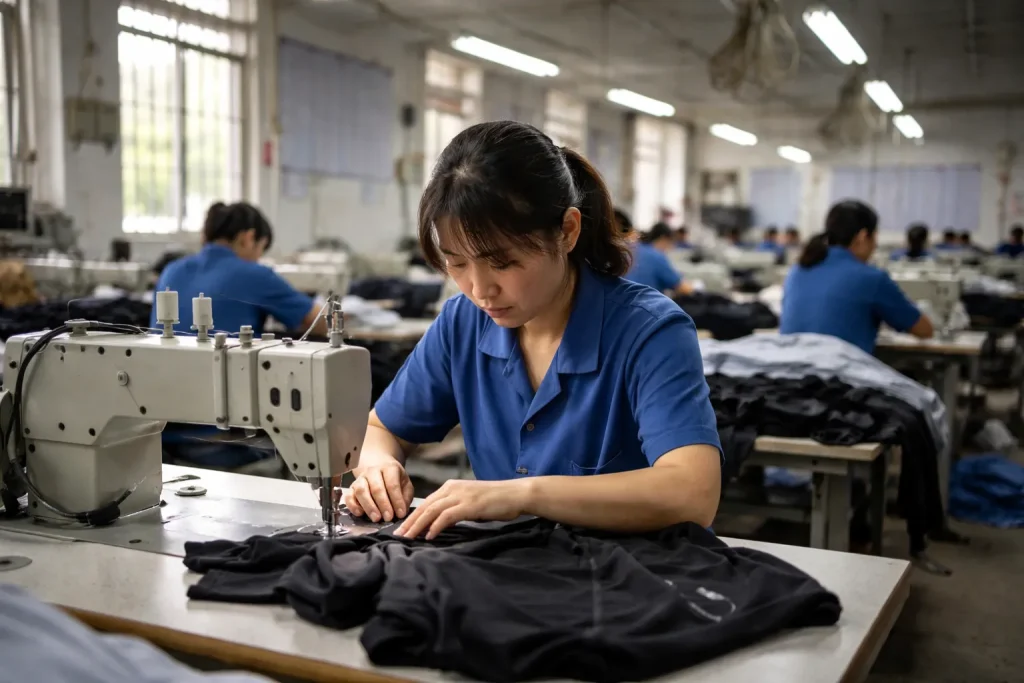
Approved samples are often produced with extra attention, while bulk production depends on:
- Fabric lot consistency
- Production line execution
- Worker training
- Process control
Cheap samples often become expensive bulk orders later.
A supplier may absorb costs during sampling to secure an order, but production challenges appear once larger quantities begin.
Buyers should always request:
- Bulk fabric approval
- Size specification approval
- Print color approval
- Packaging approval
before production starts.
4. MOQ Misunderstanding
MOQ is not simply a supplier requirement.
MOQ directly impacts:
- Fabric purchasing efficiency
- Dyeing cost
- Printing setup cost
- Production scheduling
Many buyers assume low MOQ reduces risk.
In reality, extremely low MOQ projects often increase:
- Unit cost
- Lead time
- Material limitations
Low MOQ vs Standard MOQ
| Factor | Low MOQ | Standard MOQ |
| Unit Cost | Higher | Lower |
| Fabric Options | Limited | Broader |
| Lead Time | Sometimes Longer | More Stable |
| Color Flexibility | Limited | Greater |
| Production Efficiency | Lower | Higher |
5. Lead Time Miscalculations
Buyers often focus only on sewing time.
Actual lead time includes:
- Fabric sourcing
- Lab dips
- Strike-offs
- Sample approvals
- Material testing
- Production scheduling
- Inspection
- Shipping preparation
Most delays happen during approvals, not sewing.
Many production schedules remain on track until approval cycles take longer than expected.
For sportswear and swimwear projects, approval delays commonly add 1-3 weeks.
Buyer Checklist Before Placing a Bulk Order
Before confirming production with an OEM sportswear manufacturer or private label supplier, buyers should verify the following:
Supplier Verification
- Business registration
- Export experience
- Production specialization
- Factory audit availability
- Reference projects
Product Verification
- Fabric composition
- GSM confirmation
- Stretch performance
- Color fastness
- Shrinkage results
Production Verification
- Size specification sheet
- Approved PPS sample
- Packaging standards
- Label artwork approval
- Shipping marks
Quality Verification
- Inline inspection plan
- Final inspection criteria
- AQL standards
- Third-party inspection arrangement
Sustainability Compliance Is Becoming a New Sourcing Risk
According to Textile Exchange’s recent industry reports, demand for recycled fibers continues to increase globally, particularly among sportswear and activewear brands.
Many buyers now require:
- GRS Certification
- OEKO-TEX Standard 100
- REPREVE Recycled Polyester
- ECONYL Regenerated Nylon
A supplier that cannot provide compliance documentation may create import risks or retailer approval issues later.
For brands supplying major retail chains or sports clubs, sustainability verification should be completed before order confirmation.
How Experienced Buyers Evaluate Chinese Suppliers
Rather than asking only:
“What is your price?”
Experienced buyers typically ask:
- What percentage of your production is sportswear?
- How do you control shrinkage?
- What is your average reorder rate?
- How do you manage fabric lot variation?
- What testing reports are available?
- What causes most production delays?
These questions reveal actual manufacturing capability far better than quotations alone.
Internal Resources That May Help
To further evaluate sourcing options, buyers can also review:
- OEM vs ODM Sportswear Production
- Common Swimwear Production Problems and Solutions
- Sportswear Fabric Inspection Checklist
- Sportswear Production Process
- MOQ & Lead Time FAQ
These resources help clarify specifications before supplier discussions begin.
Before You Commit to a Supplier
Reducing sourcing risks is not about finding the cheapest factory.
It is about identifying a production partner capable of delivering consistent results across sampling, manufacturing, quality control, and shipment.
The earlier risks are identified, the lower the overall sourcing cost becomes.
If you are evaluating sportswear, activewear, swimwear, fitness apparel, or private label manufacturing in China, creating a structured supplier assessment process before production starts is often the most effective risk-reduction strategy.
Conclusion
Understanding how buyers reduce sourcing risks in China requires more than comparing quotations. Successful importers, wholesalers, distributors, retail chains, and sportswear brands focus on supplier capability, fabric performance, approval procedures, compliance verification, and production management.
The most reliable sourcing outcomes typically come from buyers who invest time in validation before placing an order—not after production problems appear.
FAQ
How can I verify if a Chinese supplier is reliable?
Review business registration, export history, product specialization, quality control procedures, and production capabilities. Request audit reports, certifications, and references when available. Reliability is determined by operational consistency rather than company size alone.
Is visiting the factory necessary before placing an order?
Not always. Many international buyers rely on video audits, third-party inspections, and detailed production reviews. However, factory visits remain valuable for larger projects or long-term sourcing partnerships.
What is the biggest sourcing risk for apparel buyers?
Fabric inconsistency is often the most costly issue because it affects fit, shrinkage, color matching, and performance. Material approval before bulk production significantly reduces this risk.
How much inventory risk does MOQ create?
MOQ directly affects purchasing commitments. Ordering below economic production quantities may increase unit costs and reduce fabric options, while ordering excessive quantities increases inventory exposure.
Should buyers always conduct third-party inspections?
For first orders, high-value shipments, or retail distribution projects, third-party inspections provide an additional layer of verification and often prevent costly disputes after shipment.
References
- Textile Exchange Market Reports
- OEKO-TEX Standard 100
- SGS Textile Testing Services
- Global Recycled Standard (GRS)
- McKinsey (2025) Activewear Growth Report
Explore more insights here:
https://yunenx.com/blog/
About the Author
Yunenx Sportswear Team is a professional manufacturer specializing in custom sportswear, swimwear, and teamwear for established brands, importers, wholesalers, and retail programs worldwide.
We support buyers through every stage of the sourcing process — from product development and fabric selection to sampling, production, and bulk manufacturing — ensuring consistent quality and reliable delivery for long-term supply partnerships.
If you are sourcing a dependable sportswear or swimwear manufacturer for your next collection or seasonal program, our team is ready to support your product development and production needs.
Feel free to contact us for quotations, technical discussion, or sample evaluation.