
Last Updated: July 2, 2026 | By Yunenx Sales Team
📧 Email: [email protected]
🔗 Connect on LinkedIn
🌐 Visit our website: www.yunenx.com
💬 Chat on WhatsApp
Many buyers focus on MOQ first.
Others spend weeks comparing fabric quality or factory capacity.
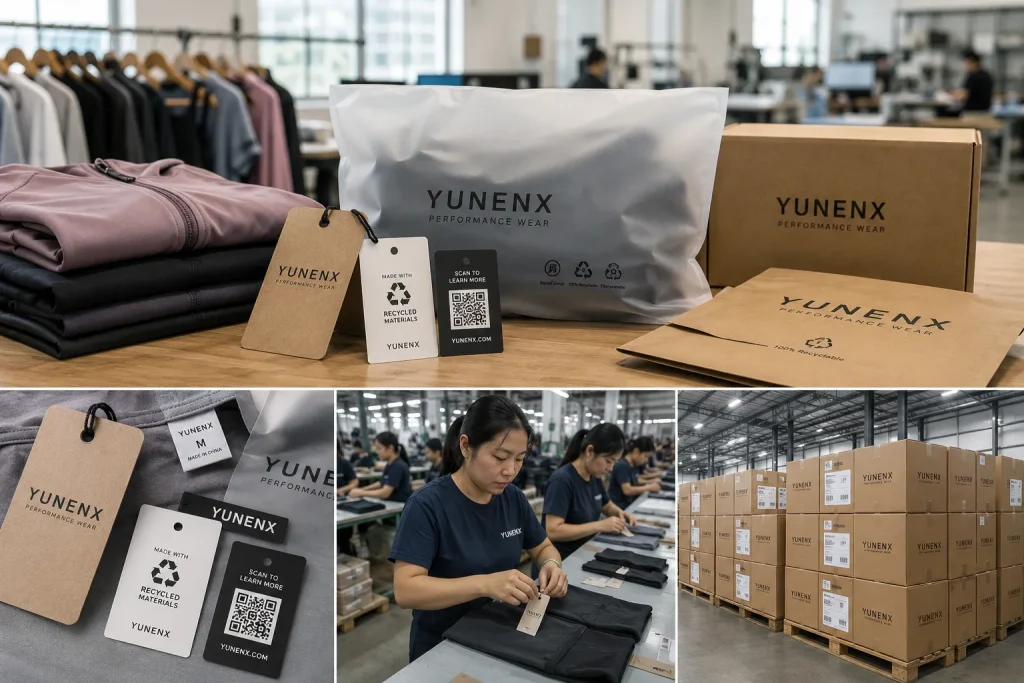
But after more than 20 years working with sportswear brands, we’ve noticed another factor that increasingly influences customer experience and retail success—packaging.
Retail packaging is no longer just about protecting products during shipping. It has become part of brand identity, sustainability strategy, warehouse efficiency, and even customer retention.
For growing sportswear brands, choosing the right packaging from the beginning can prevent unnecessary costs, production delays, and expensive redesigns later.
Packaging Is Becoming Part of the Product Experience
Consumers often interact with packaging before they even touch the garment.
Whether products are sold in boutiques, gyms, sporting goods stores, or through e-commerce, packaging influences:
- First impressions
- Perceived product value
- Brand recognition
- Sustainability image
- Return experience
- Retail shelf presentation
For B2B buyers, packaging decisions also affect production planning, inventory management, and freight costs.
What’s Changing in Sportswear Retail Packaging?
| Trend | Why Buyers Care | Factory Consideration |
|---|---|---|
| Recycled packaging materials | Meets retailer sustainability goals | Material sourcing lead time |
| Minimalist branding | Premium appearance | Printing consistency |
| QR code hangtags | Digital product information | Variable data printing |
| FSC-certified paper tags | Retail compliance | Certified suppliers required |
| Compostable polybags | Eco-friendly positioning | Higher material cost |
| Retail-ready cartons | Faster warehouse handling | Carton design planning |
Rather than adding decorative elements, many brands are simplifying packaging while improving functionality.
Packaging Often Delays Production More Than Garments
One common misunderstanding is that packaging can be finalized after bulk production starts.
In reality, packaging frequently becomes the last missing piece.
During one activewear project, garment production finished on schedule, but custom printed hangtags were delayed because the client changed the logo color after approval.
The result:
- Garments stayed in the warehouse waiting for packaging.
- Final inspection had to be rescheduled.
- Shipment was delayed nearly one week.
The garments weren’t the problem.
Packaging was.
This is why experienced suppliers always recommend confirming artwork and packaging specifications before bulk production begins.
Why Retailers Are Asking for More Sustainable Packaging
Large retailers and many online marketplaces increasingly encourage or require environmentally responsible packaging.
Common requests now include:
- FSC-certified paper hangtags
- Recycled polybags
- Soy-based printing ink
- Reduced plastic usage
- Right-sized cartons
- Easily recyclable materials
Sustainability is no longer only about recycled fabrics.
Packaging has become another important part of supplier evaluation.
Useful references:
Packaging Should Be Planned Together With Product Development
Many sourcing teams separate apparel development from packaging development.
That often creates unnecessary revisions.
A more efficient workflow looks like this:
Design Confirmation
        ↓
Brand Artwork
        ↓
Packaging Specification
        ↓
Sample Approval
        ↓
Bulk Production
        ↓
Final Inspection
        ↓
Shipment
When packaging is included early, suppliers can:
- estimate more accurate costs
- reserve printing capacity
- avoid last-minute material shortages
- reduce shipment delays
Premium Packaging Doesn’t Always Mean Higher Cost
Many buyers assume better packaging automatically increases product cost significantly.
From our experience, that’s rarely true.
We’ve worked with brands that upgraded from standard plastic bags to recyclable packaging while increasing total garment cost by less than 1%.
On the other hand, we’ve also seen expensive custom boxes dramatically increase shipping volume without improving customer satisfaction.
The best packaging decisions balance:
- branding
- logistics
- sustainability
- production efficiency
rather than simply adding premium materials.
MOQ Misunderstanding Happens Frequently
Packaging suppliers often have different MOQs than garment factories.
For example:
A sportswear factory may accept an order of 300 pieces.
However:
- custom hangtags may require 1,000 pieces
- printed zipper bags may require 2,000 pieces
- custom mailer boxes may require 500 pieces
Many first-time buyers discover this only after sample approval.
Experienced sourcing teams discuss packaging MOQs before placing production orders to avoid unexpected costs.
Risk Analysis Buyers Often Overlook
Packaging-related issues can create risks that are easy to underestimate.
| Risk | Potential Impact |
|---|---|
| Packaging artwork approved late | Shipment delay |
| Incorrect barcode placement | Retail rejection |
| Low-quality printing | Brand image damage |
| Packaging MOQ mismatch | Unexpected inventory |
| Carton size errors | Higher freight cost |
| Missing compliance labels | Customs or retailer issues |
These problems rarely appear during garment development—but often emerge just before shipment, when changes are most expensive.
Small Packaging Errors Can Trigger Large Rework Costs
We once supported a customer whose garments passed quality inspection without any issues.
However, the retail hangtags displayed the wrong color code.
Although the garments themselves were correct, every piece had to be unpacked, retagged, repacked, and inspected again.
The additional labor cost exceeded the original printing cost of the hangtags.
This is why we recommend approving both garment samples and packaging samples together whenever possible.
Choosing a Supplier That Can Support Packaging Development
When evaluating an OEM sportswear manufacturer, buyers should ask more than:
“Can you make the garments?”
They should also ask:
- Can you source certified packaging materials?
- Can you coordinate multiple packaging suppliers?
- Can you manage barcode and label accuracy?
- Can you support small MOQ branded packaging?
- Can you inspect packaging before shipment?
Suppliers experienced in private label production usually provide smoother packaging coordination throughout the project.
Final Thoughts
Retail packaging has become an extension of sportswear branding rather than a simple shipping requirement.
The most successful brands don’t choose packaging based only on appearance.
They evaluate packaging from a sourcing perspective—balancing sustainability, compliance, logistics, production timing, and customer experience.
After working with sportswear brands for more than two decades, we’ve found that early packaging planning consistently reduces delays, lowers procurement risk, and helps brands launch products more efficiently.
Recommended Reading
Internal Resources (replace with your actual URLs):
- Sportswear Quality Standards for Retail Chains
- Sportswear Collection Planning: Buyer Checklist for Successful Product Lines
- How Sportswear Categories Drive Global Retail Growth
- Sportswear Packaging Strategies for Wholesale Distribution
Authoritative References:
- https://fsc.org
- https://globalrecycled.org
- https://www.oeko-tex.com
- https://sustainablepackaging.org
FAQ
Does premium packaging always increase product costs?
Not necessarily. Many sustainable packaging upgrades add only a small percentage to the total garment cost when planned during product development.
Should packaging suppliers be selected separately from garment manufacturers?
Not always. Many experienced OEM manufacturers coordinate packaging suppliers, helping buyers simplify sourcing and reduce communication errors.
What packaging certifications do retailers commonly request?
Common requirements include FSC-certified paper, recycled materials verified under GRS, and packaging that supports recycling or reduced plastic use, depending on the retailer and market.
When should packaging artwork be finalized?
Ideally before bulk production begins. Delayed artwork approval is one of the most common reasons for shipment delays in apparel manufacturing.
About the Author
Yunenx Sportswear Team is a professional manufacturer specializing in custom sportswear, swimwear, and teamwear for established brands, importers, wholesalers, and retail programs worldwide.
We support buyers through every stage of the sourcing process — from product development and fabric selection to sampling, production, and bulk manufacturing — ensuring consistent quality and reliable delivery for long-term supply partnerships.
If you are sourcing a dependable sportswear or swimwear manufacturer for your next collection or seasonal program, our team is ready to support your product development and production needs.
Feel free to contact us for quotations, technical discussion, or sample evaluation.