
Last Updated: July 3, 2026 | By Yunenx Sales Team
📧 Email: [email protected]
🔗 Connect on LinkedIn
🌐 Visit our website: www.yunenx.com
💬 Chat on WhatsApp
Quick Answer
Retailers reduce return rates by controlling production quality before bulk manufacturing starts—not after sales.
In apparel and swimwear, most returns come from:
- inconsistent sizing between samples and bulk production
- fabric performance variation across batches
- unstable workmanship during mass production
From our experience at Quanzhou Yunenx Fashion Co., Ltd., return rate problems are almost always created at the factory stage, not at retail stage.
Sample Approval Does NOT Guarantee Production Stability
We worked with a European activewear brand producing 3,000 pcs per style.
The approved sample was perfect:
- fit confirmed
- fabric tested
- measurements aligned
But after bulk delivery:
- leggings had inconsistent compression
- waist tension varied across batches
- return rate reached double digits
What Really Happened
The sample was made by a senior technician.
Bulk production was handled by multiple operators.
Even with identical tech packs, production execution was inconsistent.
This is one of the most common hidden risks in apparel sourcing.
Solution Used in Real Factory Practice
At Yunenx, we reduce this risk by:
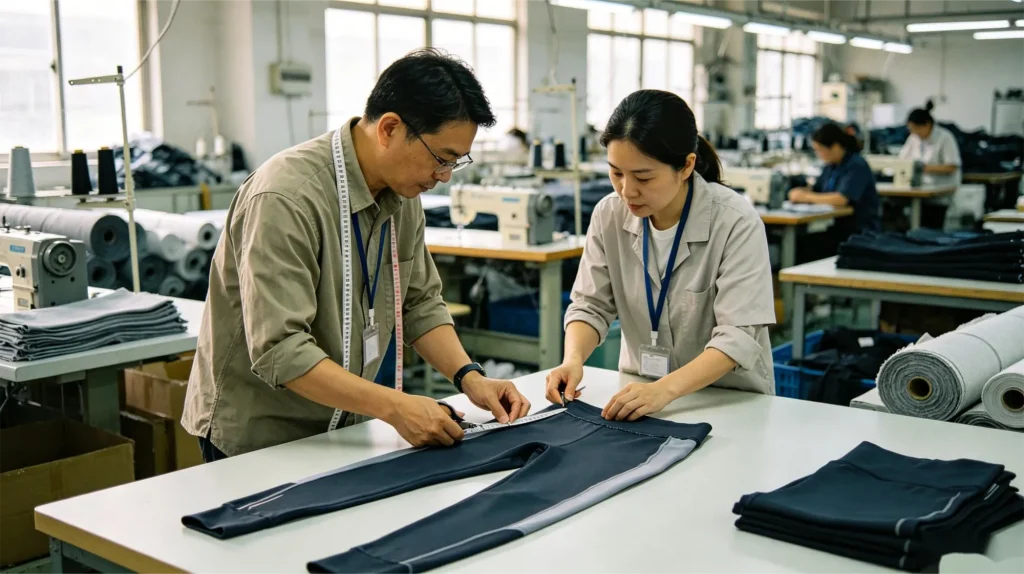
- pre-production pilot run before bulk cutting
- operator standardization checklist
- size grading validation before mass production
- inline inspection instead of only final QC
Internal references:
- Why Size Charts Matter in Apparel Manufacturing (And How They Prevent Costly Fit Mistakes)
- Quality Control Guide for Apparel Sourcing from China (2026)
Same Fabric Composition ≠ Same Performance
A fabric labeled:
80% nylon / 20% spandex, 220 GSM
can still behave differently in real production.
We’ve seen swimwear orders where:
- stretch recovery differed between batches
- compression weakened after washing
- fit inconsistency triggered customer complaints
Even when specs match, differences come from:
- yarn supplier variation
- knitting machine tension
- finishing chemical treatment
- dyeing process inconsistency
Solution
We now require:
- batch-to-batch fabric continuity testing
- wash + stretch recovery testing on finished garments
- 48-hour elasticity recovery observation
External references:
MOQ Strategy Directly Impacts Return Rate
Many startups request low MOQ:
- 50–100 pcs per style
- multiple colorways
- fast sampling cycles
But we’ve consistently observed:
👉 lower MOQ = less production stabilization = higher defect risk
Real Case
A US yoga brand launched with:
- 3 colors
- small batch production
- multiple dye lots
Result:
- shrinkage inconsistency
- fit differences between colors
- increased refund requests
Solution
We recommend:
- pilot production before scaling
- limiting color variations in first production
- unified dye batch planning
Internal link:
Where Return Rate Is Actually Created
Return rate is not a retail issue.
It is a production chain accumulation problem.
Stage-by-stage risk:
- Tech pack interpretation
- Sample development
- Production setup
- Bulk manufacturing
- Final inspection
At each step, small errors compound into retail returns.
Buyer Checklist
Retailers who successfully reduce returns always control:
- sizing system consistency before production
- fabric performance testing (not only lab report)
- pilot run validation before bulk order
- strict QC sampling standards
- supplier production capability verification
External industry references:
Why This Perspective Matters
Unlike theoretical explanations, this insight comes from real production experience in apparel and swimwear manufacturing.
At Quanzhou Yunenx Fashion Co., Ltd., we work directly with:
- activewear brands
- swimwear distributors
- sportswear importers
Across these projects, the same pattern repeats:
Return rate problems are almost always created before shipment, not after delivery.
This is why experienced buyers treat factories as part of their quality control system—not just suppliers.
Final Conclusion
Retailers reduce return rates by controlling production variability, not by fixing post-sale issues.
The real competitive advantage is:
- stable production execution
- repeatable sizing accuracy
- controlled fabric behavior
If these are managed correctly, return rates drop naturally—without increasing customer service cost.
Explore more insights here:
https://yunenx.com/blog/
About the Author
Yunenx Sportswear Team is a professional manufacturer specializing in custom sportswear, swimwear, and teamwear for established brands, importers, wholesalers, and retail programs worldwide.
We support buyers through every stage of the sourcing process — from product development and fabric selection to sampling, production, and bulk manufacturing — ensuring consistent quality and reliable delivery for long-term supply partnerships.
If you are sourcing a dependable sportswear or swimwear manufacturer for your next collection or seasonal program, our team is ready to support your product development and production needs.
Feel free to contact us for quotations, technical discussion, or sample evaluation.