
Last Updated: September 8, 2026 | By Yunenx Production Team
📧 Email: [email protected]
🔗 Connect on LinkedIn
🌐 Visit our website: www.yunenx.com
💬 Chat on WhatsApp
Recently, we encountered an unexpected quality issue with a batch of custom sports jerseys made from polyester-spandex jacquard fabric.
After the customer received and wore the jerseys, they reported white fibers or fuzz appearing on certain areas of the fabric surface.
The issue was visible in customer-provided photos, particularly on the dark-colored jerseys.
At first, it appeared to be a fabric surface problem. However, after investigating the production process and arranging third-party laboratory testing, the situation turned out to be more complicated.
The fabric had been produced by the supplier many times before, without similar complaints.
This raised an important question:
If the fabric has been successfully produced many times and the submitted printed fabric passes laboratory testing, why did the surface problem appear after the jerseys were used?
This case is still under investigation, but it has given us several important lessons about sportswear quality control.
What Did the Customer Report?
The customer provided photos showing white, fiber-like marks appearing on the surface of the jerseys.
The affected areas did not simply look like conventional round pills.
In some areas, the fibers appeared to be pulled or exposed on the fabric surface, creating visible streaks or patches.
Because the garments were already in use, we needed to consider not only the original fabric but also the different processes the fabric went through before and after production.
Possible Causes We Considered
When a problem appears on a finished sports garment, it is tempting to immediately blame the fabric.
However, the finished product has normally passed through several stages:
Yarn and raw materials
Knitting
Dyeing and finishing
Sublimation printing
Cutting and sewing
Heat transfer or numbering
Washing and wearing
Mechanical friction during actual use
Therefore, we decided to investigate the entire process instead of making an immediate conclusion.
What Did the BV Laboratory Test Show?
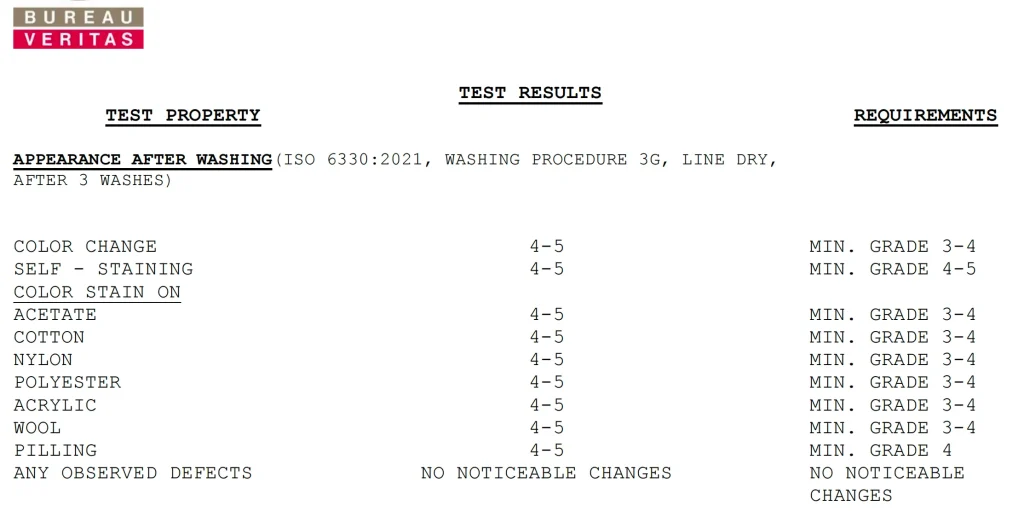
To obtain more objective information, we submitted the printed fabric sample to Bureau Veritas (BV) for testing.
The report was issued on September 7, 2026.
The submitted fabric was 95% polyester and 5% elastane and was intended for sportswear.
The overall test result was rated PASS.
Several important results were as follows.
The appearance after three washing cycles showed no noticeable changes.
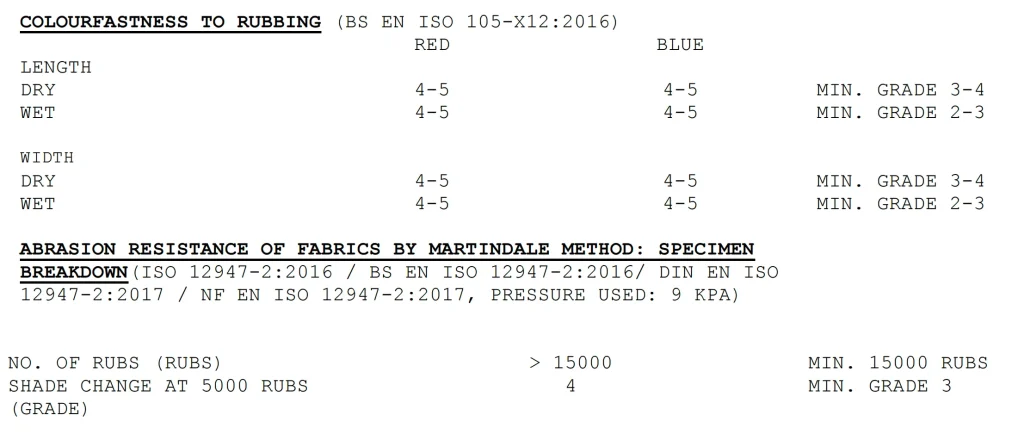
Colourfastness to dry and wet rubbing was rated 4–5 for both the red and blue samples.
The Martindale abrasion resistance was greater than 15,000 cycles, meeting the stated minimum requirement of 15,000 cycles.
The modified Martindale pilling, fuzzing or matting test achieved Grade 4–5 after 500 cycles, compared with the minimum requirement of Grade 3–4.
These results were generally positive.
Based on the submitted sample, the standard laboratory tests did not indicate an obvious problem with pilling, washing appearance, colourfastness or the specified abrasion requirement.
However, this did not completely explain the customer’s experience.
Why Can a Fabric Pass Laboratory Testing but Still Develop a Surface Problem?
This is one of the most important points we learned from this case.
Laboratory testing is performed under specific test methods and controlled conditions.
Real-life sportswear use can be very different.
A football jersey may experience repeated stretching, friction and contact with other surfaces during training and matches.
The garment may rub against another garment, a seat, sports equipment, a bag or other materials.
The direction, pressure and frequency of this friction can also vary considerably.
Therefore, passing a standard laboratory test does not necessarily mean that a garment will never show any surface change under every possible real-life condition.
It means that the submitted sample met the requirements under the specified test conditions.
Could It Be Traditional Pilling?
At this stage, we do not want to describe the problem simply as pilling.
The BV pilling/fuzzing/matting result was Grade 4–5, which was a good result under the specified test method.
The appearance in the customer’s photos also looks different from typical small pills distributed across the fabric surface.
Some areas appear more like exposed or pulled surface fibers.
This is why we are also paying attention to the fabric’s snagging and surface structure characteristics.
What About Snagging and Surface Fibers?
The BV snagging test produced an average grade of 3–4.
The report classifies Grade 4 as slight surface defects and Grade 3 as moderate surface defects under the test method.
The report also includes filamentation, or fiber splitting, as one of the possible types of surface defect.
This does not prove that snagging or filamentation caused the customer’s problem.
However, it gives us another direction for investigation.
The next step is to understand whether the white surface fibers seen on the garments could be related to localized mechanical friction or changes in the fabric structure.
Could Sublimation Printing Be a Factor?
Sublimation printing is another process we considered.
Polyester sportswear fabrics are commonly exposed to relatively high temperatures during sublimation.
The effect of temperature, pressure and processing time on the fabric surface therefore needs to be considered.
However, the current BV report does not prove that sublimation caused the problem.
The submitted printed fabric passed the requested tests.
To investigate this possibility more thoroughly, a useful approach would be to compare the original fabric with fabric after sublimation and examine whether their surface performance changes after further mechanical testing.
Could Heat Pressing Player Names and Numbers Cause the Problem?
We also considered another possibility.
Football clubs and teams sometimes apply player names, numbers and sponsor logos after receiving the garments.
If the heat press temperature or pressure is too high, or the pressing time is too long, the fabric may potentially be affected.
We therefore asked the customer about the actual process they used.
The customer reported that the numbers were applied at approximately 120°C for 10 seconds.
Our usual reference for this type of sticker application is around 140°C for 8–10 seconds.
Based on the information currently available, 120°C for 10 seconds does not appear to be an obviously excessive setting.
Therefore, we cannot currently identify heat pressing as the main cause.
However, equipment temperature and actual fabric temperature can sometimes differ, so this possibility can be investigated further through a controlled comparison test.
What We Are Investigating Now
At this stage, we are looking at several possible factors rather than assigning responsibility to one particular process.
These include:
Raw material and yarn characteristics
Knitting and fabric finishing
Fabric surface structure
Sublimation temperature and processing conditions
Heat transfer after garment delivery
Mechanical friction during actual wear
The interaction between several of these factors
A controlled comparison test can help narrow down the possibilities.
For example, samples can be compared before and after sublimation, before and after heat pressing, and after simulated abrasion.
The purpose is to determine whether the surface changes are related to a specific production process or to the way the finished garment is used.
What This Case Has Taught Us About Sportswear Quality Control
One important lesson from this case is that quality problems are not always simple.
A fabric can have a good production history.
A submitted sample can pass third-party laboratory testing.
A finished garment can pass normal factory inspection.
And yet, an unexpected surface problem can still appear after real-life use.
This does not automatically mean that the laboratory test was wrong or that the fabric was defective.
It means that standard testing and real-life use are two different environments.
For sportswear, this distinction is particularly important because garments are exposed to repeated movement, stretching, friction, sweat, washing and sometimes additional heat-transfer processes.
For this reason, quality control should consider the complete product lifecycle rather than looking at only one production stage.
We Are Still Looking for the Root Cause
At the time of writing this case study, we have not identified one confirmed root cause.
The BV test results are generally positive, and the printed fabric sample passed the requested laboratory requirements.
The customer’s actual experience, however, still needs to be explained.
We are therefore continuing to communicate with the fabric supplier and review the production and usage conditions.
Rather than making a quick assumption, we want to identify the actual mechanism behind the surface change.
Once the root cause is confirmed, we can use the findings to improve fabric selection, production control and testing requirements for future sportswear orders.
Conclusion
This case reminded us that sportswear quality control does not end when a fabric passes a laboratory test or when a garment passes final inspection.
The actual performance of a sports garment depends on the interaction between fabric construction, manufacturing processes, printing, finishing and real-life use.
When an unexpected problem occurs, the most useful approach is to investigate the complete supply chain, compare different processing stages and use testing to separate facts from assumptions.
We are still investigating this case.
But that is also an important part of real apparel sourcing: sometimes the correct answer is not immediately obvious.
The goal is not simply to find someone to blame.
The goal is to understand what happened and prevent the same problem from happening again.
Case Status: Under Investigation
Laboratory test: Passed
Pilling/fuzzing: Grade 4–5
Abrasion resistance: >15,000 cycles
Colourfastness to rubbing: Grade 4–5
Washing appearance: No noticeable changes
Root cause: Still under investigation
External References
- Textile Exchange Industry Reports
- McKinsey Apparel Value Chain Insights
- World Trade Organization Textile Overview
- Business of Fashion Supply Chain Analysis
Internal Resources (Yunenx Guides)
- White Surface Fuzz on Polyester-Spandex Jerseys: A Real Quality Case Study
- Sportswear Packaging Strategies for Wholesale Distribution
- Common Quality Issues Buyers Find in Activewear Production
- Swimwear Fabric Selection Guide for Buyers
About the Author
Yunenx Sportswear Team is a professional manufacturer specializing in custom sportswear, swimwear, and teamwear for established brands, importers, wholesalers, and retail programs worldwide.
We support buyers through every stage of the sourcing process — from product development and fabric selection to sampling, production, and bulk manufacturing — ensuring consistent quality and reliable delivery for long-term supply partnerships.
If you are sourcing a dependable sportswear or swimwear manufacturer for your next collection or seasonal program, our team is ready to support your product development and production needs.
Feel free to contact us for quotations, technical discussion, or sample evaluation.