
Last Updated: June 22, 2026 | By Yunenx Sales Team
📧 Email: [email protected]
🔗 Connect on LinkedIn
🌐 Visit our website: www.yunenx.com
💬 Chat on WhatsApp
According to Textile Exchange (2025), global demand for performance textiles and recycled synthetic fibers in sportswear has grown by double digits year-on-year, especially driven by women’s activewear, athleisure, and swimwear segments. At the same time, McKinsey reports that “sport-led lifestyle apparel” is now one of the fastest-growing retail categories in global fashion.
From a manufacturing and sourcing perspective, this growth is not just a trend—it is reshaping how brands develop collections, choose suppliers, and manage production risk.
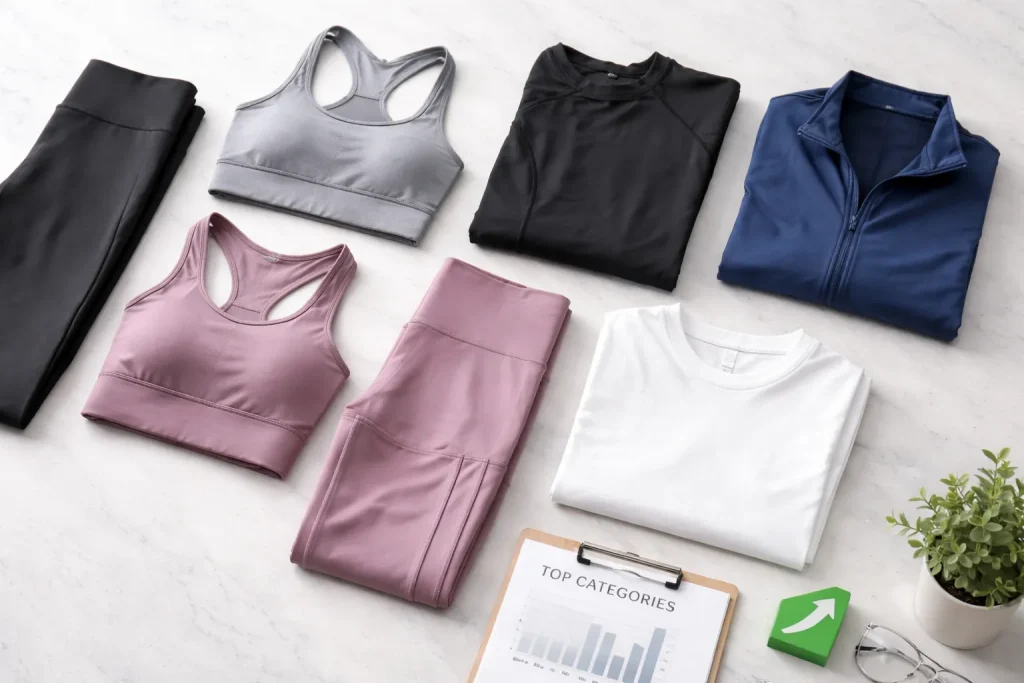
Sportswear growth is not uniform. It is driven by specific categories where fit, fabric performance, and speed-to-market matter more than traditional fashion cycles.
From our factory-side experience, three categories consistently drive repeat orders:
- Athleisure leggings & bras (high frequency reorder)
- Performance swimwear (high margin, high technical risk)
- Teamwear / custom sets (bulk orders, tight deadlines)
We also see a clear pattern: brands that succeed are those that treat suppliers as development partners, not just “price vendors”.
Most retail brands entering sportswear expansion face the same hidden issue:
They underestimate how different each category behaves in production.
For example:
- Swimwear looks simple but has the highest defect sensitivity
- Seamless activewear has low MOQ expectations but high machine constraints
- Teamwear seems basic but often fails in color consistency and delivery timing
A common sourcing mistake we observe:
Buyers assume “sportswear = one category,” but factories treat it as 5–6 completely different production systems.
Procurement Logic
Retail growth in sportswear is actually driven by three procurement shifts:
1. From seasonal buying → continuous replenishment
Athleisure is now reordered monthly instead of seasonal drops.
2. From design-heavy → fabric-performance driven
Fabric recovery, compression, and colorfastness often matter more than styling.
3. From single factory → multi-specialist sourcing
Brands increasingly split suppliers:
- one for swimwear
- one for seamless leggings
- one for teamwear
📌 Internal reference:
- Build Your Own Sportswear Brand with OEM & ODM Experts
- Sportswear Wholesale Profit Margin Breakdown: What Buyers Often Overlook
From our production floor experience in Fujian and cooperative factories across Zhejiang, we consistently see three realities:
Seamless activewear is capacity-limited, not demand-limited
Even when demand is strong, circular knitting machines are the bottleneck. One factory told us:
“We reject orders not because of price, but because machines are booked 30–45 days ahead.”
Swimwear has the highest rework rate in sampling
We often see first samples rejected due to:
- chest coverage misalignment
- elastic tension inconsistency
- lining transparency under stretch
This leads to 2–3 rounds of correction even for experienced brands.
Retail buyers underestimate dye consistency risk
In teamwear orders, even a slight shade variation leads to rejection at warehouse level.
This is especially common when buyers switch between factories without unified color standards.
📌 External reference:
- https://textileexchange.org
- https://www.mckinsey.com
- https://www.statista.com/topics/1145/sportswear/
One European startup we worked with wanted to launch a mixed collection:
- leggings
- sports bras
- swimwear sets
Their initial assumption:
“Same fabric base, different styles, should be one factory.”
Reality after sampling:
- leggings passed first sample
- bras required full pattern adjustment
- swimwear failed twice due to lining tension
Final solution:
We split production into two factories:
- seamless activewear specialist
- swimwear-focused factory with sublimation + lining expertise
Result:
- development time reduced by 35%
- defect rate reduced significantly in bulk production
- better retail consistency
📌 Internal reference:
From our sourcing experience, before selecting a sportswear supplier, buyers should verify:
- Does the factory specialize in your category (not just “sportswear” in general)?
- Can they show real bulk production photos, not only samples?
- Do they understand fabric behavior under stretch?
- Do they have repeat orders from similar brands?
Most importantly:
Ask how many re-samples they typically require per category. That reveals real capability more than any brochure.
A practical sourcing flow we see working for growing brands:
- Define category priority (swimwear / activewear / teamwear)
- Match factory specialization (not just MOQ capability)
- Run 1–2 controlled sampling cycles
- Lock fabric + color standard before scaling
- Split suppliers if production risk increases
Sportswear retail growth looks strong, but sourcing risks are also increasing:
1. MOQ misunderstanding
Many buyers assume “low MOQ = flexibility,” but in reality it often means higher defect tolerance risk.
2. Lead time distortion
Factories often quote sample fast but underestimate bulk queue time.
3. Quality inconsistency at scale
Even good samples may not reflect bulk production stability.
Another consistent issue we observe:
Brands that scale too fast often ignore fabric batch variation.
One client increased from 300 pcs to 3000 pcs order without re-confirming fabric lot:
- result: slight GSM variation
- caused rejection from retail warehouse
This is not a design issue—it is a production scaling discipline issue.
Case Study
A US DTC brand expanded leggings sales rapidly through ads.
They placed:
- 1 small trial order
- then immediately scaled 10x
But they did not:
- lock color standard Pantone code
- confirm fabric shrinkage after wash test
Outcome:
- return rate increased
- warehouse rework cost exceeded margin gain
Lesson:
In sportswear, scaling without revalidation is more dangerous than slow growth.
Sportswear categories are driving retail growth globally, but from a sourcing perspective, the winners are not the brands with the best designs.
They are the brands that understand:
- each category behaves like a different manufacturing system
- supplier specialization matters more than low price
- scaling requires controlled validation, not repetition
At Yunenx, what we see daily is simple:
the gap between “sample success” and “bulk success” is where most retail growth either accelerates—or breaks.
📌 Internal links:
- Building Long-Term Sportswear Supply Chains
- Common Sportswear Importing Mistakes and How to Avoid Them
- Sportswear Import Trends in Europe: What Buyers Should Know
References
- Textile Exchange Market Reports
- OEKO-TEX Standard 100
- SGS Textile Testing Services
- Global Recycled Standard (GRS)
- McKinsey (2025) Activewear Growth Report
Explore more insights here:
https://yunenx.com/blog/
About the Author
Yunenx Sportswear Team is a professional manufacturer specializing in custom sportswear, swimwear, and teamwear for established brands, importers, wholesalers, and retail programs worldwide.
We support buyers through every stage of the sourcing process — from product development and fabric selection to sampling, production, and bulk manufacturing — ensuring consistent quality and reliable delivery for long-term supply partnerships.
If you are sourcing a dependable sportswear or swimwear manufacturer for your next collection or seasonal program, our team is ready to support your product development and production needs.
Feel free to contact us for quotations, technical discussion, or sample evaluation.