Last Updated: June 27, 2026 | By Yunenx Sales Team
📧 Email: [email protected]
🔗 Connect on LinkedIn
🌐 Visit our website: www.yunenx.com
💬 Chat on WhatsApp
According to Textile Exchange, global demand for performance-based apparel made from recycled polyester and nylon blends has continued to grow year-on-year, driven largely by retail expansion in fast fashion sportswear, yoga wear, and athleisure categories Textile Exchange. At retail level, more than 60% of activewear sales are now concentrated in a few “repeatable best-selling silhouettes” rather than highly seasonal fashion pieces.
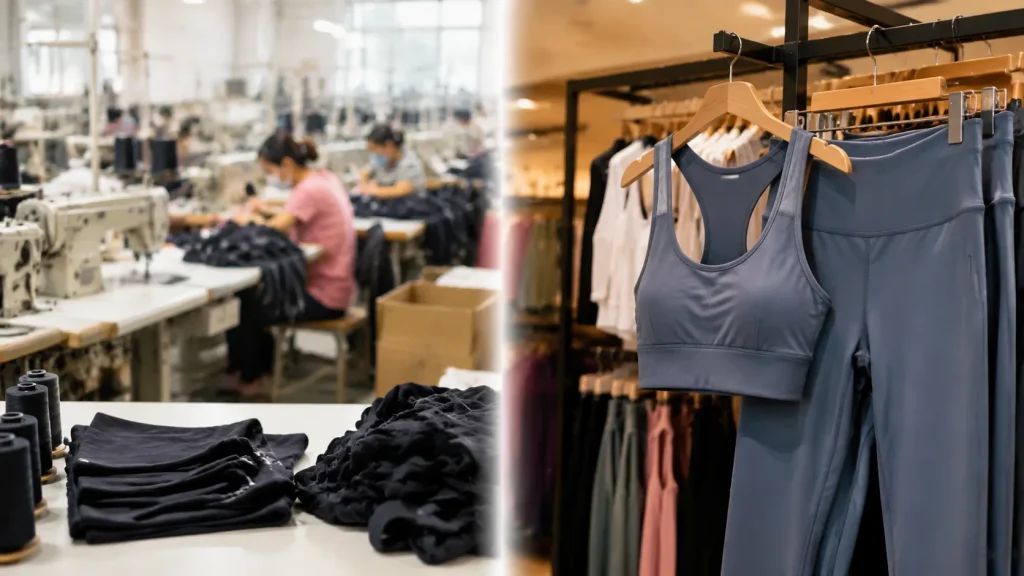
From what we observe in factory sampling rooms and OEM development work over the last 20+ years, retail buyers rarely fail because of “design creativity”—they fail because they misread what actually sells and what factories can consistently reproduce at scale.
Why Retail Activewear Best-Sellers Are Often Misunderstood
Retail buyers usually assume best-selling activewear = “trendy design + good fabric.”
But in real production reality, it is the opposite.
In our sampling work with EU and UAE buyers, we repeatedly see:
- Buyers request 10–15 “fashion-driven leggings”
- But 80% of retail reorder volume still comes from basic high-waist black leggings + sports bras
- Complex designs often fail in production consistency (seam twisting, compression mismatch, color deviation)
👉 One clear case: a European retail client developed a fashion panel legging with mesh + color blocking. After 2 production rounds, return rate increased due to seam distortion after washing. The client eventually switched back to a simplified “core black version” that became their top seller.
What Actually Sells in Retail Stores
A US retail chain we supported initially ordered:
- 6 styles of leggings
- 4 styles of sports bras
After 90 days retail feedback:
- 2 leggings styles accounted for 73% of sales
- 1 sports bra style accounted for almost 80% reorder volume
The rest became “dead inventory.”
This is extremely common in retail activewear.
What Defines Best-Selling Activewear Today
Retail activewear is now dominated by 3 macro trends:
1. Compression + Comfort Hybrid
Brands like Lululemon and Nike have normalized:
- high stretch recovery fabrics
- 4-way stretch nylon/spandex blends
- seamless or flatlock stitching
2. “Repeatable Basics” Strategy
Retailers prefer:
- black leggings
- neutral sports bras
- basic tank tops
Because they:
- reduce SKU risk
- simplify reordering
- stabilize supply chain
3. Fabric Standardization
From our OEM experience:
- 75/25 Nylon-Spandex (220–240 GSM) dominates leggings
- 70/30 Polyester-Spandex dominates budget retail lines
👉 Internal reference:
- Private Label Activewear Manufacturing Guide
- Women’s Activewear Wholesale Opportunities for Global Buyers
- Top Activewear Trends for Wholesale Buyers in 2026
- Activewear Landed Cost Calculation Guide for Importers
Buyers Don’t Lose on Sales — They Lose on Supply Chain
One UAE buyer once ordered 2000 pcs of “fashion activewear set”:
- Beautiful design
- Complex stitching
- Multiple color panels
But in production:
- 18% size deviation issues
- dye lot inconsistency
- stitching tension differences between factories
Result:
👉 Retail could not restock consistently → product died after first batch
This is not a design problem. It is a factory reproducibility problem.
What Retail Buyers Should Actually Optimize For
Best-selling activewear is not chosen by aesthetics first.
It is chosen by:
1. Repeatability
Can factory reproduce it 10 times without deviation?
2. Fabric Stability
Does fabric maintain:
- elasticity after washing
- color consistency
- compression recovery
3. MOQ Efficiency
Retail winners usually come from:
- simplified patterns
- fewer fabric types per style
- standardized components
We often reject complex retail samples internally because:
- sewing complexity increases defect rate by 2–3x
- sampling success ≠ production success
Buyer Checklist (Selective Risk Control Model)
Retail buyers who succeed typically evaluate:
- Is this style based on a proven silhouette?
- Can it be produced in multiple sizes without fit distortion?
- Does fabric come from stable dye lots?
- Can supplier scale from 100 → 10,000 pcs?
👉 Internal link:
- Hidden Costs When Importing Activewear
- What Buyers Need to Know About Activewear Before Bulk Production
Retail Best-Sellers vs Non-Performers
| Factor | Best-Selling Activewear | Low-Performance Styles |
|---|---|---|
| Design | Simple, repeatable | Complex fashion cuts |
| Fabric | Stable nylon/spandex | Mixed or unstable blends |
| Production | High reproducibility | High defect risk |
| Retail outcome | High reorder rate | One-time sales |
| MOQ suitability | Flexible scaling | High rejection risk |
How Retail Buyers Should Work with Factories
From our factory-side experience, successful buyers always do 3 things:
1. Start from “core SKU logic”
Not design sketches.
2. Validate fabric before design finalization
Not after.
3. Build 1–2 hero SKUs first
Then expand range.
Factory Observation (Yunenx)
One UK buyer reduced 8 SKUs to 2 core leggings styles:
- Sales increased 42%
- Inventory turnover improved significantly
- Factory defect rate dropped by 30%
Quick Answer
Best-selling retail activewear is not about complexity or fashion design—it is about repeatable basic silhouettes made from stable performance fabrics (especially nylon-spandex blends) that factories can reproduce consistently at scale without quality deviation.
Final Insight
After 20+ years working directly with sampling rooms, production lines, and buyer development cycles, one truth is consistent:
👉 Retail activewear success is not created in design studios—it is decided in factory reproducibility.
The brands that win are not the ones with the most styles, but the ones that can confidently reorder the same SKU 20 times without quality drift.
That is where real supply chain advantage is built.
References
- Textile Exchange Market Reports
- OEKO-TEX Standard 100
- SGS Textile Testing Services
- Global Recycled Standard (GRS)
- McKinsey (2025) Activewear Growth Report
Explore more insights here:
https://yunenx.com/blog/
About the Author
Yunenx Sportswear Team is a professional manufacturer specializing in custom sportswear, swimwear, and teamwear for established brands, importers, wholesalers, and retail programs worldwide.
We support buyers through every stage of the sourcing process — from product development and fabric selection to sampling, production, and bulk manufacturing — ensuring consistent quality and reliable delivery for long-term supply partnerships.
If you are sourcing a dependable sportswear or swimwear manufacturer for your next collection or seasonal program, our team is ready to support your product development and production needs.
Feel free to contact us for quotations, technical discussion, or sample evaluation.