Last Updated: May 29, 2026 | By Yunenx Production Team
📧 Email: [email protected]
🔗 Connect on LinkedIn
🌐 Visit our website: www.yunenx.com
💬 Chat on WhatsApp
What is a swimwear quality inspection guide, and why is it important for buyers sourcing swimwear from overseas manufacturers?
As swimwear brands face increasing competition, product quality has become one of the biggest factors influencing customer retention, online reviews, and return rates. According to recent industry reports from SGS and McKinsey, apparel quality issues remain one of the leading causes of returns in fashion e-commerce. For swimwear brands, even minor defects such as seam breakage, fabric transparency, color bleeding, or poor fit can result in costly claims and damaged brand reputation.
For importers, wholesalers, retail chains, and resortwear brands, understanding a proper swimwear quality inspection process helps reduce sourcing risks, improve production efficiency, and avoid expensive surprises after shipment.
Quick Answer
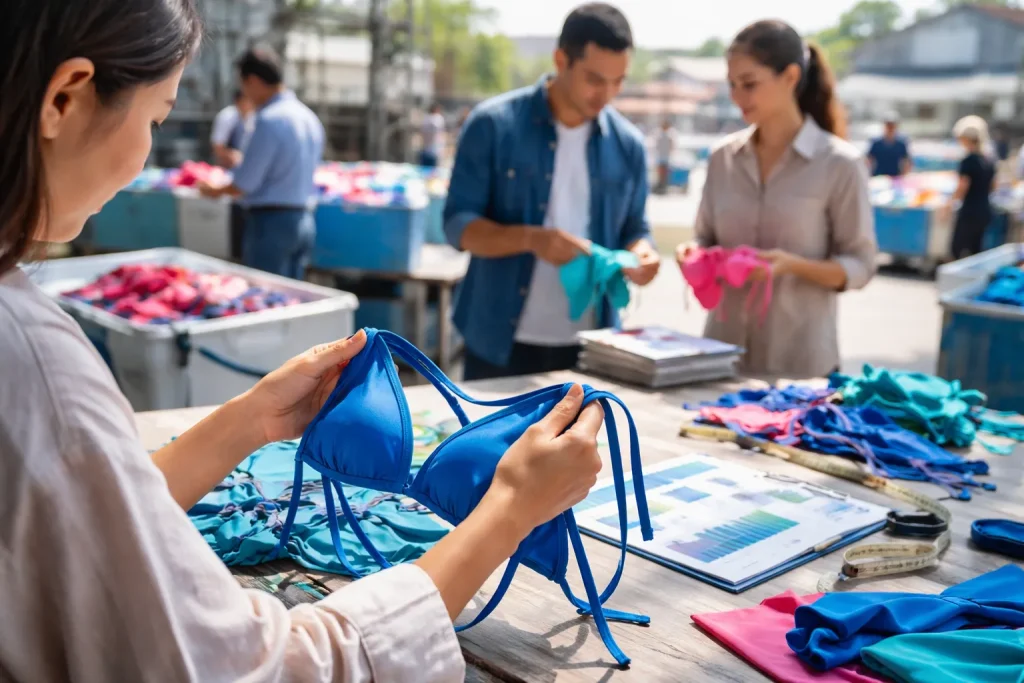
A swimwear quality inspection guide helps buyers verify fabric performance, stitching quality, sizing accuracy, color consistency, labeling compliance, and packaging standards before shipment. The most critical checkpoints include stretch recovery, seam strength, color fastness, chlorine resistance, UPF performance, measurement tolerance, and visual defect inspection. Identifying problems before shipment is significantly less expensive than dealing with returns or replacements after products reach customers.
Why Swimwear Quality Inspection Matters More Than Regular Apparel
Unlike casual clothing, swimwear operates under harsher conditions:
- Constant exposure to chlorine
- Saltwater environments
- UV radiation
- Repeated stretching
- Wet-to-dry cycles
A bikini or one-piece swimsuit may look perfect during sample approval but fail after several uses if quality controls are insufficient.
For buyers working with an OEM Sportswear Manufacturer or Activewear Supplier China, inspection should not be viewed as a final step. It should be integrated throughout the entire production process.
Common quality failures include:
| Issue | Customer Impact | Cost Impact |
|---|---|---|
| Fabric transparency | Customer complaints | Returns and refunds |
| Poor stretch recovery | Misshapen garments | Brand reputation damage |
| Color bleeding | Product rejection | Replacement costs |
| Weak seams | Product failure during use | Warranty claims |
| Incorrect sizing | High return rates | Additional logistics expenses |
Key Fabric Inspection Points Buyers Should Check
Fabric Composition Verification
The actual fiber content should match approved specifications.
Typical commercial swimwear fabrics include:
- 80% Nylon / 20% Spandex
- 78% Recycled Nylon / 22% Elastane
- 75% Polyester / 25% Elastane
Request supplier testing reports whenever possible.
If your brand promotes sustainability claims, certifications such as OEKO-TEX®, GRS (Global Recycled Standard), ECONYL®, or REPREVE® should be verified before production begins.
Stretch and Recovery Performance
Swimwear relies heavily on elasticity.
A simple inspection method includes:
- Stretch fabric by 30%-50%
- Hold for several seconds
- Release
- Observe recovery speed
Poor recovery often indicates insufficient spandex quality or improper knitting structure.
Fabric Weight (GSM)
Buyers should verify actual GSM against approved standards.
Typical ranges:
| Product Type | Common GSM |
| Fashion Bikini | 180-220 GSM |
| Performance Swimwear | 200-260 GSM |
| Compression Swimwear | 240-300 GSM |
A difference of 20-30 GSM can significantly affect opacity and fit.
Seam Construction Inspection Checklist
Seam quality directly affects durability.
The most common constructions include:
| Construction | Typical Use | Buyer Consideration |
| Overlock | Entry-level swimwear | Lower cost |
| Flatlock Stitching | Performance swimwear | Improved comfort |
| Cover Stitch | Decorative areas | Appearance focused |
Inspection Points
Check for:
- Skipped stitches
- Broken threads
- Uneven seam tension
- Open seam gaps
- Needle damage
Fabric may look identical across suppliers. Seam quality often reveals the true manufacturing capability.
We frequently see sample garments pass approval while bulk production experiences seam consistency issues due to operator differences.
Measurement and Fit Inspection
Sizing problems remain one of the most expensive post-shipment issues.
Buyers should establish:
- Measurement specification sheet
- Tolerance standards
- Grading rules
Common tolerance ranges:
| Measurement Type | Tolerance |
| Bust | ±1 cm |
| Waist | ±1 cm |
| Hip | ±1 cm |
| Strap Length | ±0.5 cm |
Inspect random samples throughout production rather than relying solely on final inspection.
Most fit-related delays occur during approval stages, not during sewing production.
Brands often underestimate how many fitting revisions are required before achieving desired sizing consistency.
Color Fastness and Chlorine Resistance Testing
Color stability is critical for swimwear.
Recommended tests include:
Color Fastness to Washing
Verify:
- Shade retention
- Dye migration
- Staining on adjacent fabrics
Chlorine Resistance
Particularly important for:
- Swim teams
- Sports clubs
- Training swimwear
- Performance collections
Low chlorine resistance can cause fading within weeks.
UV Performance
For markets such as Australia, New Zealand, and resort destinations, UPF 50+ performance is often requested.
Buyers should request laboratory verification instead of relying on supplier claims.
Packaging and Label Inspection
Inspection should continue beyond garment construction.
Verify:
Care Labels
Must match:
- Fabric composition
- Country of origin requirements
- Local regulatory standards
Barcode Accuracy
Especially important for:
- Retail chains
- Department stores
- Distribution centers
Packaging Consistency
Check:
- Polybag size
- Size stickers
- Hangtags
- Carton markings
Common Buyer Mistakes During Swimwear Inspection
Mistake 1: Approving Only Visual Appearance
A swimsuit may appear perfect but fail stretch or chlorine tests.
Mistake 2: Skipping Pre-Production Samples
This increases risk of:
- Fabric substitutions
- Construction changes
- Measurement deviations
Mistake 3: Inspecting Too Late
Finding issues after shipment can multiply correction costs by five to ten times.
Cheap samples often become expensive bulk orders later.
Many production issues originate from rushing sample approval without fully validating materials and construction details.
Buyer Inspection Process Before Shipment
A practical swimwear quality inspection workflow:
Step 1
Approve:
- Fabric
- Color
- Trim
- Measurement specs
Step 2
Conduct Pre-Production Meeting
Confirm:
- Construction details
- Label placement
- Packaging requirements
Step 3
Inline Inspection
Check:
- First production pieces
- Stitch quality
- Measurement consistency
Step 4
Final Random Inspection
Inspect:
- Appearance
- Measurements
- Packaging
- Carton quantity
Step 5
Shipment Release
Approve shipment only after all critical defects are cleared.
Procurement Risk Analysis
Fabric Shrinkage Risk
Risk: Unexpected dimensional change.
Consequence: Customer sizing complaints.
Cost Impact: Returns and replacement orders.
Color Variation Risk
Risk: Shade inconsistency between batches.
Consequence: Mixed inventory appearance.
Cost Impact: Retail rejection.
MOQ Misunderstanding
Risk: Assuming sample fabric can be used in bulk.
Consequence: Fabric substitutions.
Cost Impact: Re-development delays.
Lead Time Misjudgment
Risk: Late material approvals.
Consequence: Shipment delays.
Cost Impact: Lost selling season.
How Buyers Evaluate a Reliable Swimwear Production Partner
A reliable swimwear manufacturer should provide:
- Material traceability
- Inspection procedures
- Testing support
- Consistent quality records
- Transparent communication
When evaluating a production partner, buyers should ask about:
- Chlorine resistance testing
- UPF 50+ verification
- Stretch recovery standards
- Measurement control procedures
- Bulk inspection process
These factors are often more important than simply comparing prices.
Need Help Evaluating Swimwear Quality Before Bulk Production?
Whether you are launching a new resortwear brand, sourcing for a retail chain, supplying sports clubs, or expanding a private label swimwear collection, establishing a structured swimwear quality inspection process can significantly reduce sourcing risks.
At Yunenx, we work with buyers during sampling, material selection, production monitoring, and pre-shipment inspections to help identify potential quality issues before they become costly problems.
You may also find these resources useful:
- Swimwear Fabric Library
- Custom Swimwear Production Process
- MOQ Guide for Swimwear Brands
- Swimwear Sampling FAQ
Conclusion
A professional Swimwear Quality Inspection Guide for Buyers is not simply a final inspection checklist. It is a risk management system covering fabric verification, seam construction, fit control, testing standards, packaging compliance, and shipment approval.
Buyers who implement structured inspections typically experience fewer quality claims, lower return rates, and more consistent production outcomes. The earlier quality issues are identified, the lower the overall sourcing cost becomes.
📌 External reference:
- Textile Exchange: https://textileexchange.org
- SGS testing standards: https://www.sgs.com
- OEKO-TEX certification: https://www.oeko-tex.com
FAQ
How many pieces should be inspected during final swimwear inspection?
Most third-party inspections follow AQL standards and inspect a statistically representative sample rather than every piece. The exact quantity depends on order volume and risk level.
What is the most common swimwear quality issue?
Sizing inconsistency and stretch recovery problems are among the most frequent issues seen in bulk production. Both can significantly impact customer satisfaction.
Is chlorine resistance necessary for all swimwear?
Not always. Fashion swimwear may not require the same chlorine performance as competitive swimwear or swim team uniforms. Requirements should match the end-use application.
Should buyers test UPF 50+ claims independently?
Yes. If UV protection is part of your marketing message, independent laboratory verification is strongly recommended before mass production.
When should quality inspection begin?
Inspection should start during material approval and continue through sampling, production, and final shipment stages. Waiting until finished goods inspection is often too late.
Can third-party inspection companies replace factory quality control?
No. Third-party inspections provide an additional layer of verification but cannot replace daily factory quality management throughout production.
📌 Internal reference:
Custom Swimwear Manufacturer for Startups
How to Choose a Reliable Swimwear Factory China
About the Author
Yunenx Sportswear Team is a professional manufacturer specializing in custom sportswear, swimwear, and teamwear for established brands, importers, wholesalers, and retail programs worldwide.
We support buyers through every stage of the sourcing process — from product development and fabric selection to sampling, production, and bulk manufacturing — ensuring consistent quality and reliable delivery for long-term supply partnerships.
If you are sourcing a dependable sportswear or swimwear manufacturer for your next collection or seasonal program, our team is ready to support your product development and production needs.
Feel free to contact us for quotations, technical discussion, or sample evaluation.