
Last Updated: May 22, 2026 | By Yunenx Production Team
📧 Email: [email protected]
🔗 Connect on LinkedIn
🌐 Visit our website: www.yunenx.com
💬 Chat on WhatsApp
Quick Answer:
Custom high-performance activewear manufacturers provide compression leggings with precise fabric composition, 4-way stretch, UPF 50+ protection, flatlock stitching, and low MOQ support. They manage lab dip approval, fit testing, and bulk production to ensure consistent quality and performance for gym apparel startups and boutique fitness brands.
Introduction
What is compression leggings manufacturing? Compression leggings are high-performance activewear designed to improve blood circulation, muscle support, and comfort during workouts. The market for these products is rapidly expanding, driven by fitness enthusiasts, boutique gyms, and athleisure consumers. For B2B buyers—brand owners, sourcing managers, and startup fitness labels—finding a reliable custom high-performance activewear manufactureris crucial. Core challenges include fabric selection, compression level consistency, color fastness, and ensuring low MOQ support without compromising quality.
Key Takeaways
- Fabric composition: 78–85% nylon or polyester with 15–22% elastane for 4-way stretch
- GSM weight: 220–300 gsm for medium to high compression
- Compression level: 15–25 mmHg for general fitness, up to 30 mmHg for performance use
- UPF protection: UPF 50+ for outdoor workouts
- Flatlock stitching: Prevents chafing and maintains stretch durability
- Color fastness: ≥4 grade per ISO 105
- MOQ support: 50–200 pcs per color/style for startups
What It Is: Industry Background & Market Trends
Compression leggings are a segment of performance activewear, where innovation in functional textiles drives market differentiation. Modern compression fabrics incorporate moisture-wicking, antibacterial, and seamless construction technologies.
Industry Trends
- Sustainability: Increasing demand for ECONYL regenerated nylon or REPREVE recycled polyester aligns with Textile Exchange sustainability initiatives. According to Textile Exchange (2025), recycled polyester usage in activewear grew by 12% YoY.
- Compression technology: Leggings are engineered with graduated compression zones for specific muscle groups. Fitness brands now demand precision fit across all sizes.
- Seamless construction & sublimation printing: Reduces stitching failures and allows full-color branding options for boutique and resortwear lines.
Cheap samples often become expensive bulk orders later. A fabric may pass lab testing but curl during stitching if elastane stability is weak. Startups frequently underestimate the number of fit revisions needed—one sample round often turns into three.
Key Factors for Procurement
| Factor | Parameter | Impact & Risk |
|---|---|---|
| Chlorine resistance | ≥400 hours for synthetic nylon | Essential for studio wear; low resistance may fade in frequent washing |
| UPF protection | 50+ | Outdoor training use; improper testing can lead to warranty claims |
| 4-way stretch | 15–25% elongation recovery | Critical for compression level; low recovery causes sagging |
| Compression level | 15–30 mmHg | Under or over compression affects performance and customer satisfaction |
| GSM weight | 220–300 gsm | Affects warmth, durability, and muscle support |
| Fabric composition | 78–85% nylon/polyester, 15–22% elastane | Wrong ratio causes shrinkage or poor elasticity |
| Color fastness | ≥4 ISO 105 | Prevents fading; critical for multi-color sublimation |
| Seam construction | Flatlock recommended | Reduces chafing; poor stitching increases returns |
Step-by-Step Procurement Guide
- Material selection – Confirm recycled nylon/polyester grade and elastane percentage.
- Tech pack confirmation – Include compression zones, stitch type, and color references.
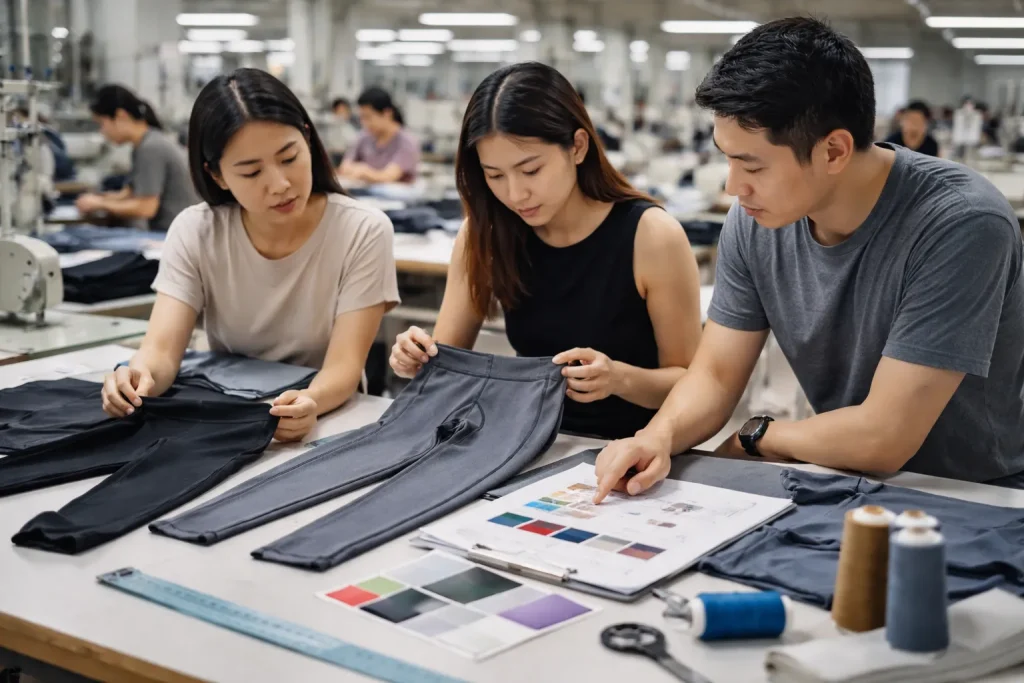
- Lab dip approval – Test fabric color under daylight, indoor light, and after wash cycles.
- Sampling stage – Produce 1–2 prototypes; ensure compression levels meet spec.
- Fit testing – Evaluate on different body shapes; expect 1–3 revision rounds.
- Bulk production – Confirm GSM, color consistency, seam quality, and labeling.
- Quality inspection – Include random compression testing, flatlock seam check, and colorfastness measurement.
- Shipping & risk control – Consider lead time, potential shrinkage, and customs compliance.
- Don’t skip fit testing; saving time often backfires during bulk production.
- Confirm elastane stability; it’s common for leggings to curl or lose compression after 10 washes.
Factory Reality Layer
- Observation: Some fabrics pass lab tests but fail in sewing due to elastane instability.
- Industry Pitfall: Buyers sometimes skip lab dip approval; color mismatch in bulk is costly.
- Real Scenario: Startups underestimate revision rounds—one sample round typically turns into three before compression consistency is achieved.
Common Mistakes
- Skipping sampling – Leads to sizing errors, poor compression, and reworks.
- Ignoring fabric testing – Shrinkage or curling during sewing.
- No size spec confirmation – Misfit across S–XL sizes, higher returns.
- Unrealistic lead time expectation – Delays in production or shipping.
- Choosing suppliers only by price – Lower quality and higher long-term costs.
Explore more about our production capabilities:
https://yunenx.com/sportswear/
https://yunenx.com/activewear/
https://yunenx.com/swimwear/
B2B Comparison Table
| Comparison | China Factory | Vietnam Factory | Trading Company |
|---|---|---|---|
| MOQ | 50–200 pcs | 100–300 pcs | Often 300+ pcs |
| Recycled fabrics | ECONYL & REPREVE | Limited selection | Uncertain |
| Seam type | Flatlock / seamless | Cut-and-sew | Varies |
| Lead time | 25–35 days | 35–45 days | 40+ days |
| Fit revision support | 1–3 rounds | 1–2 rounds | Rarely included |
| Risk mitigation | QC inspection & lab dip | QC only | Minimal |
Checklist Before Bulk Production
- Fabric composition approved
- Size chart validated
- Lab dip approved
- PPS sample approved
- QC standard confirmed
- Packaging requirements clear
- Lead time aligned
FAQ + Quick Answers
What is the MOQ?
50–200 pcs per style/color depending on fabric and supplier.
What is the lead time?
Typically 25–35 days for bulk production after sample approval.
Do you support customization?
Yes, including compression zones, color, stitching, and labeling.
What fabrics are used?
78–85% nylon/polyester with 15–22% elastane; options for ECONYL or REPREVE.
Do you support eco-friendly fabrics?
Yes, recycled fabrics are available and certified by GRS and OEKO-TEX.
External Authority Reference
- Textile Exchange
https://textileexchange.org
Ready to develop your custom compression leggings collection?
Yunenx supports low MOQ activewear manufacturing, recycled fabric sourcing, OEM/ODM development, and bulk production management for growing brands.
Contact us to request samples or pricing support.
Related Articles
- Compression Wear Manufacturing Guide
- Compression Wear Fabric Guide
- MOQ for Compression Wear Bulk Orders
Explore more insights here:
https://yunenx.com/blog/
About the Author
Yunenx Sportswear Team is a professional manufacturer specializing in custom sportswear, teamwear and swimwear for global brands and sports clubs. The team supports brands from product development to bulk manufacturing.
If you are looking for a reliable custom sportswear manufacturer,
our factory specializes in sportswear, swimwear and activewear production for growing brands.
Feel free to contact us for sampling or quotation. Connect on LinkedIn | Email | www.yunenx.com
Written by Yunenx Team
Reviewed by Production Specialist
Last Updated: May 2026