By Yunenx Manufacturing Team LinkedIn | [email protected] | www.yunenx.com
The Mistake I See Every Week {#mistake}
Last month, a CrossFit apparel brand sent me samples of their new “premium” joggers. The left leg had a 4-color gradient logo that looked stunning—until I washed it twice. The DTF print started peeling at the edges, and the white base showed through the cracks. They’d chosen DTF for the “premium look” but used it on a high-stretch panel where HTV would have outperformed.
Here’s what I told them: Choosing the wrong decoration method is like using a Ferrari for off-roading. Both DTF and HTV are excellent tools, but each has terrain where it excels and fails.
After eight years managing production for 200+ sportswear brands, I’ve learned that decoration method selection isn’t about “which is better”—it’s about which fits your specific fabric, design complexity, and durability requirements.
This guide breaks down the technical realities, cost structures, and durability data you need to make the right call for your sportswear line.
Related: Before choosing decoration methods, ensure your size charts and measurement specs are locked. Decoration issues often stem from garment fit problems.
How DTF Actually Works (And Where It Shines) {#dtf}
The Four-Step Process
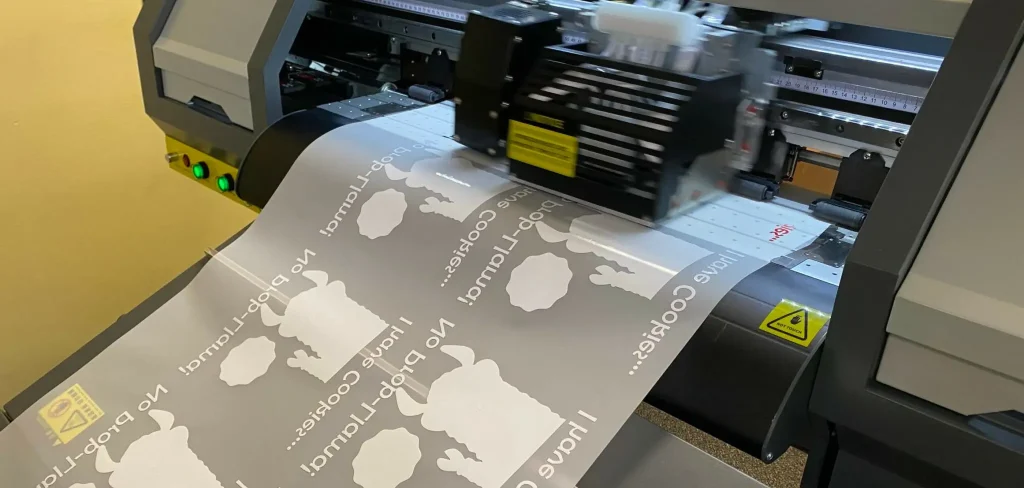
DTF (Direct-to-Film) printing—what many call “Roland Printing” after the popular Roland VersaStudio BN-20D and BY-20 systems—follows a precise workflow:
- Print to PET film: CMYK+White inks print onto specialized transfer film. The white ink layer creates opacity for dark fabrics.
- Powder application: TPU (thermoplastic polyurethane) adhesive powder is evenly distributed over the wet ink while still on the film.
- Curing: The powdered film passes through a heat source (conveyor dryer or heat press hover) at 110-130°C for 8-15 seconds, melting the powder into a textured, adhesive layer .
- Heat transfer: The cured film is pressed onto fabric at 160-165°C for 15-20 seconds, then peeled (hot or cold depending on film type).
Critical technical detail: The TPU powder particle size matters. Standard range is 0-80μm for fine detail, 80-200μm for general use, and 150-250μm for heavy coverage . Using the wrong powder size for your design complexity creates adhesion failures.
Where DTF Dominates
Complex, multi-color designs: DTF handles gradients, photorealistic images, and unlimited colors in one pass. No layering required. For a 5-color basketball jersey logo with fade effects, DTF saves 30-40 minutes of production time per garment compared to HTV layering .
Fabric versatility: DTF adheres to cotton, polyester, nylon, rayon, and blends—both light and dark fabrics. Unlike sublimation, it doesn’t require 100% polyester or light colors .
Production speed: Once you have the transfer, application takes 15-20 seconds. A single operator can process 500+ garments per hour with pre-made transfers .
Deep Dive: Learn how DTF powder curing temperatures affect wash durability on different fabric weights.
The Hidden Costs Nobody Talks About
Equipment investment: Entry-level Roland BY-20 systems start around $3,500-4,500, while production-grade TY-300 units run $15,000+. You’ll also need a shaker/dryer unit ($2,000-5,000) for automated powder application .
Consumables complexity: You’re managing four variables—ink, film, powder, and curing parameters. Get one wrong, and the entire batch fails. I see 15-20% material waste in the first three months of DTF adoption.
Maintenance reality: White ink requires daily agitation and weekly printhead cleaning. Skip this, and you’re looking at $800+ printhead replacements .
HTV: The Old Workhorse That Still Delivers {#htv}
The Three-Step Process
Heat Transfer Vinyl (HTV) is elegantly simple:
- Cut: A vinyl cutter (Roland, Cricut, or Silhouette) cuts the design from colored polyurethane (PU) or PVC film. The blade cuts through the vinyl but not the carrier sheet.
- Weed: Excess vinyl is manually removed (“weeded”), leaving only the design on the carrier.
- Press: Heat and pressure (typically 150-160°C for 10-15 seconds) activate the adhesive, bonding the vinyl to fabric .
Critical technical detail: For multi-color designs, you layer vinyls—but each layer adds thickness and requires “tack pressing” (2-3 seconds) before the final full press. A 3-color design needs three separate weeding steps and careful registration .
Where HTV Still Wins
Specialty finishes: Metallic foil, glitter, holographic, 3D puff, reflective—these effects are impossible with DTF’s flat ink layer. For safety gear or fashion-forward athletic wear, HTV’s texture options are unmatched .
Durability on stretch: High-quality PU vinyl withstands 50+ washes with minimal degradation. On high-stretch panels (underarm gussets, waistbands), HTV’s flexibility often outperforms DTF’s rigid ink layer .
Low barrier to entry: A quality vinyl cutter ($300-800) and heat press ($200-500) get you started. No ink maintenance, no powder mess, no curing ovens .
Tool: Download our HTV layering technique checklist for complex multi-color sportswear designs.
The Labor Trap
Weeding time: A simple name takes 30 seconds. A detailed mascot logo with fine lines? 10-20 minutes per garment. For a 100-piece team order, that’s 16+ hours of labor versus DTF’s press-and-peel efficiency .
Layering complexity: Each color adds another press cycle. Get the registration wrong, and you’re re-pressing or starting over. On polyester performance fabrics, excessive heat from multiple presses can cause scorching or dye migration.
Head-to-Head: The Data You Need {#comparison}
| Factor | DTF Printing | Heat Transfer Vinyl (HTV) | Winner |
|---|---|---|---|
| Setup cost | $5,000-20,000+ | $500-1,300 | HTV |
| Per-unit cost (1-25 pieces) | $1.05-1.95 | $3-5 (labor-intensive) | DTF |
| Per-unit cost (500+ pieces) | $1.05-1.95 | $0.80-1.50 | HTV |
| Design complexity | Unlimited colors, gradients | 1-3 colors practical | DTF |
| Production speed | 500+/hour (with transfers) | 10-20/hour (complex weeding) | DTF |
| Wash durability | 20-50 washes (with care) | 50+ washes | HTV |
| Stretch performance | Rigid, may crack on high-stretch | Flexible, moves with fabric | HTV |
| Specialty effects | Flat finish only | Metallic, glitter, puff, reflective | HTV |
| Fabric compatibility | All fabrics, all colors | Most fabrics, all colors | Tie |
*Sources: Industry production data , wash testing protocols *
My Production Floor Tests: Three Real Scenarios {#tests}
Test 1: Basketball Jersey Numbers (High-Volume, Simple Design)
The job: 200 jerseys, 2-color numbers (white base, team color outline).
DTF approach: Printed transfers arrived in 2 days. Application: 200 jerseys × 2 numbers × 20 seconds = 2.2 hours total. Cost: $1.40 per number set.
HTV approach: Cut and weeded in-house. 200 jerseys × 2 numbers × 5 minutes weeding = 33 hours. Plus layering time. Cost: $0.90 materials + labor.
Verdict: DTF wins decisively on labor efficiency. The break-even point for HTV is around 500+ pieces where labor costs amortize.
Test 2: Yoga Leggings with Gradient Print (Complex, Stretch Fabric)
The job: 150 leggings, full-color gradient mandala design on 75% nylon/25% spandex.
DTF approach: Beautiful print, but after 10 wash cycles, micro-cracking appeared at the hip flex point. The rigid ink layer couldn’t handle the 4-way stretch.
HTV approach: Not viable—the gradient required 6+ color layers, creating a thick, uncomfortable “sweat patch” effect.
Verdict: Sublimation was the actual answer here (which we recommended). DTF and HTV both failed for different reasons. This illustrates why decoration method selection requires understanding fabric behavior, not just design complexity.
Related: Read our complete guide to sportswear fabric selection for decoration methods.
Test 3: CrossFit Team Shirts (Durability Priority)
The job: 50 shirts, simple 1-color logo, high-intensity workout use with frequent washing.
DTF approach: After 25 washes, edge lifting and color dulling. The TPU adhesive degraded under repeated hot washing (members ignored care instructions).
HTV approach: Premium PU vinyl showed minimal wear after 50 washes. The solid vinyl layer withstood the abuse better than DTF’s powder-based adhesion.
Verdict: HTV for durability-critical applications. The “premium” DTF look wasn’t worth the longevity trade-off for this use case.
Decision Framework: Which Method for Your Project? {#decision}
Choose DTF If:
- [ ] Design has 3+ colors, gradients, or photorealistic elements
- [ ] Order quantity is 1-100 pieces (small batch, on-demand)
- [ ] Fabric is dark-colored or 100% synthetic
- [ ] Production speed is critical (same-day turnaround)
- [ ] You have equipment budget and technical maintenance capacity
Choose HTV If:
- [ ] Design is 1-2 colors with simple shapes/text
- [ ] You need specialty finishes (metallic, reflective, puff)
- [ ] Garment has high-stretch panels (compression wear, leggings)
- [ ] Durability is priority over visual complexity
- [ ] You’re starting with limited capital ($1,500 vs. $15,000+)
The Hybrid Approach (What We Recommend)
Most successful sportswear brands use both methods strategically:
- DTF for: Complex logos, small batch custom orders, dark fabric bases
- HTV for: Numbers/names, specialty effects, high-stretch areas, durability-critical pieces
Example: A basketball uniform might use DTF for the front chest logo (complex, multi-color) and HTV for back numbers (simple, high-wear area).
Service: Not sure which method fits your specific design? Send us your artwork at [email protected] for a free production method recommendation.
External Resources (Authority Links)
- Textile Exchange (Sustainability data): https://textileexchange.org
- McKinsey Fashion Report: https://www.mckinsey.com/industries/retail
- Statista Swimwear Market Data: https://www.statista.com
Conclusion
DTF and HTV aren’t competitors—they’re complementary tools in a complete decoration arsenal. The “best” method depends on your specific design complexity, fabric type, order volume, and durability requirements.
After managing thousands of sportswear production runs, my rule is simple: DTF for visual impact and speed, HTV for durability and specialty effects. The brands that master both methods, and know when to deploy each, are the ones that scale profitably.
The real cost isn’t in the equipment—it’s in choosing wrong and dealing with returns, remakes, or damaged brand reputation.
Connect on LinkedIn | [email protected] | www.yunenx.com
Related Resources
- Pattern vs Size Chart: Why Your Factory Needs Both
- Fabric Selection Guide for Sportswear Decoration
- DTF Curing Temperature & Powder Guide
- HTV Layering Techniques for Multi-Color Designs
- Quality Control Checklist for Decorated Apparel
Have a decoration method question or production challenge? From Olympic team uniforms to boutique yoga lines, I’ve tested every combination of DTF, HTV, sublimation, and screen printing. Drop me a line—I’m always happy to help brands optimize their decoration workflows.
👤 About the Author
Yunenx Sportswear Team is a professional manufacturer specializing in custom sportswear, yoga wear, swimwear, and teamwear for global brands.
With years of experience in OEM & ODM production, we help brands turn ideas into best-selling products. Connect on LinkedIn | Email | www.yunenx.com