Last Updated: July 4, 2026 | By Yunenx Sales Team
📧 Email: [email protected]
🔗 Connect on LinkedIn
🌐 Visit our website: www.yunenx.com
💬 Chat on WhatsApp
Two factories can quote the same garment.
The final result may be completely different — especially in retail sportswear programs where consistency, replenishment, and brand identity matter more than unit price.
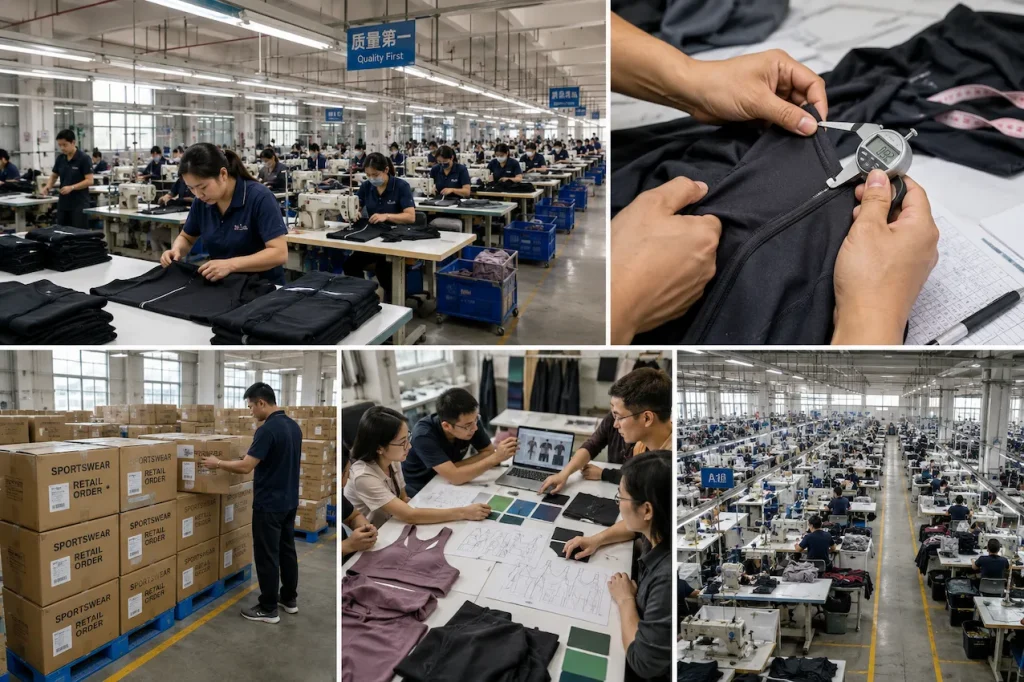
At Quanzhou Yunenx Fashion Co., Ltd, we have seen this gap repeatedly over 20+ years of production and sourcing experience: buyers don’t lose money because of “high price”, they lose money because the program was not built as a system.
An exclusive retail sportswear program is not a single bulk order — it is a structured supply system combining:
- Stable fit across repeated production
- Controlled fabric consistency
- Repeatable MOQ logic for retail replenishment
- Clear grading rules for multi-store distribution
Most failed programs in sportswear do not fail at design stage — they fail at repeat production stability and supplier interpretation gaps.
Key Takeaways
- Exclusive retail programs are supply-chain systems, not products
- MOQ misunderstanding is one of the biggest hidden risks in retail expansion
- Fabric “same composition” ≠ same performance in real production
- Supplier capability matters more than sample approval quality
- Replenishment logic must be designed before first production
What Buyers Usually Misjudge
“Same sample, different bulk result”
We once produced a women’s activewear set for a European retailer. Sample approval was perfect.
But in bulk:
- Compression level dropped slightly
- Waistband elasticity varied between batches
Reason was not fabric change — it was tension calibration difference between sewing lines.
This is something most buyers cannot see at sample stage.
MOQ misunderstanding kills retail programs
Many buyers think MOQ is just “minimum quantity”.
In reality, MOQ affects:
- fabric dye consistency batch size
- cutting efficiency
- production line allocation
- price stability in replenishment
We often see buyers mix 3–5 colors under one SKU thinking it reduces risk — but it actually increases color deviation risk in repeat orders.
Internal reference:
Retail programs fail at second reorder
First order is usually fine.
Second reorder is where problems appear:
- fabric lot difference
- shrinkage inconsistency
- stitching tension shift
This is the point where many suppliers cannot maintain continuity.
That is why retail programs must be designed as long-term production logic, not one-time sampling.
Cost Breakdown
Retail pricing is often misunderstood. Cost is not just fabric + labor.
Typical structure:
- Fabric (35–45%)
- Labor (20–30%)
- Trims & accessories (10–15%)
- Quality control + rework buffer (5–10%)
- Program management + repeat stability cost (10–15%)
Hidden cost factor (most ignored):
Repeat production alignment cost
This is where experienced factories differ from trading-only suppliers.
Internal reference:
Standard Order vs Retail Program
| Factor | Standard Bulk Order | Retail Sportswear Program |
|---|---|---|
| Purpose | One-time shipment | Continuous replenishment |
| Fabric control | Batch-based | Lot consistency required |
| MOQ logic | Flexible | Structured |
| Quality focus | Pass/fail | Repeatability |
| Risk level | Medium | Low (if system is correct) |
Buyer Checklist
Not every project needs full checklist discipline, but retail programs require at least:
- Fabric lot confirmation before bulk cutting
- Pre-production sealing sample
- Color standard (lab dip + bulk reference)
- Size grading approval across full range
- Reorder simulation (at least 1 mini test run)
Internal reference:
UK Retail Expansion Program
A UK brand approached us to scale from online sales into retail stores.
Initial request:
- 4 styles
- 2 colors each
- 200 pcs/style
What actually happened:
Stage 1 (sample phase)
Everything approved quickly.
Stage 2 (bulk production)
We detected:
- slight fabric stretch difference between colors
- waistband recovery inconsistency in dark dye batch
Stage 3 (correction)
We adjusted:
- dye batch grouping
- tension calibration per color
- cutting lay consistency
Result:
Retail rollout succeeded, but only after correcting production logic — not design.
This is a typical pattern in retail sportswear expansion.
Retail sportswear programs are shifting toward:
- smaller but repeated orders
- faster replenishment cycles
- tighter SKU control
- higher consistency expectations
This trend is driven by:
- online retail fragmentation
- inventory risk reduction
- brand differentiation pressure
External references:
- https://www.nike.com (brand supply model reference)
- https://www.adidas-group.com (retail distribution system overview)
- https://textileexchange.org (sustainable supply chain standards)
- https://www.iso.org/standard/72464.html (quality management systems in manufacturing)
What Actually Matters
From factory-side observation:
- Buyers over-focus on “first sample approval”
- But under-focus on “second production repeatability”
- Most cost loss happens after launch, not before launch
A strong supplier is not the one who makes a perfect sample.
It is the one who can reproduce it 10 times without deviation.
If you are building a retail sportswear program and want to reduce repeat production risk, we can help structure:
- sampling logic
- MOQ planning
- fabric stability control
- production replication system
More details:
https://yunenx.com/sportswear
Or explore our manufacturing capabilities:
https://yunenx.com/swimwear
About the Author
Yunenx Sportswear Team is a professional manufacturer specializing in custom sportswear, swimwear, and teamwear for established brands, importers, wholesalers, and retail programs worldwide.
We support buyers through every stage of the sourcing process — from product development and fabric selection to sampling, production, and bulk manufacturing — ensuring consistent quality and reliable delivery for long-term supply partnerships.
If you are sourcing a dependable sportswear or swimwear manufacturer for your next collection or seasonal program, our team is ready to support your product development and production needs.
Feel free to contact us for quotations, technical discussion, or sample evaluation.