Last Updated: April 22, 2026 | By Yunenx Production Team
📧 Email: [email protected]
🔗 Connect on LinkedIn
🌐 Visit our website: www.yunenx.com
💬 Chat on WhatsApp
What is the difference between 4-way stretch and 2-way stretch fabric for yoga wear, and why does it matter for your OEM/ODM sourcing decisions?
When you are sourcing custom high-performance activewear manufacturer for yoga collections, the stretch fabric specification is not just a technical detail – it determines how your garments perform in downward dog, how they survive 500+ wash cycles, and whether your customers will come back for more. Many brand founders assume all stretch fabrics are the same. They are not. Choosing between 4-way stretch and 2-way stretch directly impacts compression level, recovery rate, durability, and your customer’s comfort during a 75-minute hot yoga session.
We’ve spent 12 years manufacturing for yoga and activewear brands from Australia to Germany. The most common regret we hear? “I wish I understood the stretch spec before bulk production.” This guide walks you through the technical, practical, and sourcing differences so you can make the right call for your next collection.
Key Takeaways
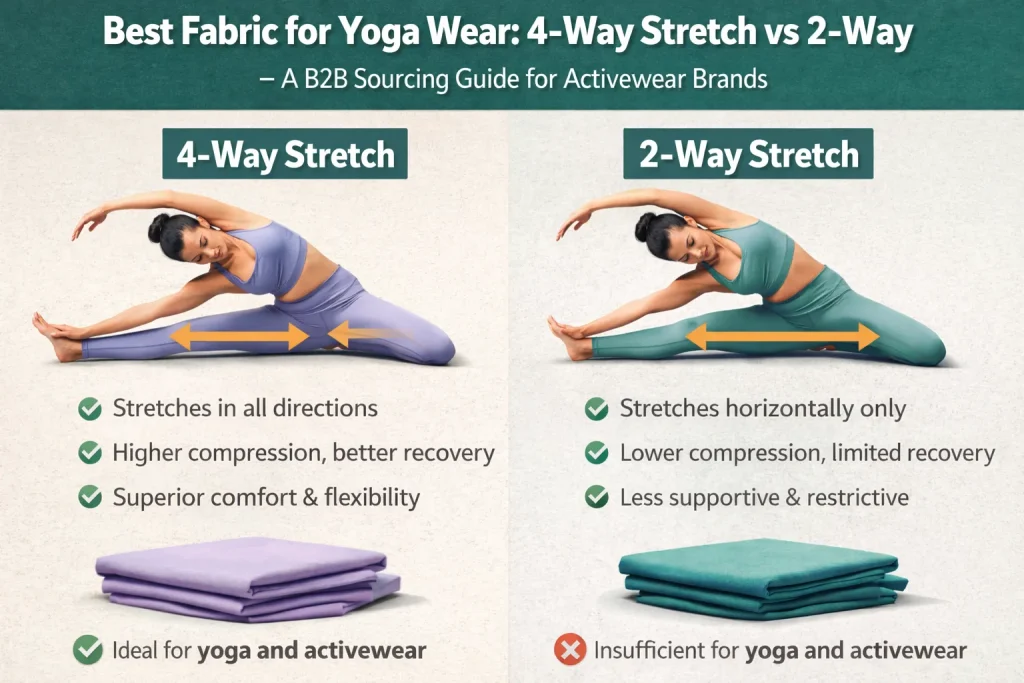
- 4-way stretch fabric stretches in both length and width directions; 2-way stretch only stretches in one direction (usually width).
- For yoga wear that involves twisting, lunging, and full-range motion, 4-way stretch is the industry standard for premium collections.
- 2-way stretch works for specific applications like waistbands, certain jacket panels, or budget-conscious yoga pants.
- Sourcing the wrong stretch type leads to baggy knees, sagging waistbands, and customer returns.
- OEM suppliers like Yunenx offer custom fabric development with specific stretch and recovery percentages.
What It Is: Understanding Stretch Fabric for Yoga Wear
Stretch fabric is defined by how many directions it can expand and recover. The yoga wear market reached $47.2 billion globally in 2023, according to Statista, with high-performance fabric demand growing at 8.3% annually. Within this category, stretch specification is a primary decision point.
2-way stretch fabric uses spandex/elastane fibers woven or knitted to stretch along the weft (horizontal) direction but not the warp (vertical). Common compositions include 90% nylon / 10% spandex in a single-knit construction. Recovery is directional, meaning the fabric returns to shape along the stretch axis but has minimal recovery on the non-stretch axis.
4-way stretch fabric uses circular knit or warp knit construction with spandex integrated evenly. It stretches both lengthwise and crosswise, typically with 30-50% elongation in both directions. Premium yoga fabrics often use 78-82% recycled nylon with 18-22% spandex for optimal recovery. The market is shifting toward circular economy materials – Textile Exchange reported that recycled polyester and nylon usage in activewear grew 42% between 2020 and 2023.
From a factory perspective: 4-way stretch requires more precise knitting tension control and higher-quality spandex yarns. That impacts cost, lead time, and minimum order quantities. But for yoga wear specifically – where the body moves in multiple planes – 4-way stretch is not marketing hype. It’s functional necessity.
Key Factors: Technical Comparison for B2B Decision Making
When evaluating suppliers for yoga wear production, use these technical parameters – not vague terms like “good quality” or “soft fabric.”
| Parameter | 4-Way Stretch | 2-Way Stretch | Yoga Wear Relevance |
|---|---|---|---|
| Elongation (%) | 40-60% (length), 50-70% (width) | <15% (length), 40-60% (width) | Hip flexion requires 45%+ elongation |
| Recovery rate | 90-95% after 100 cycles | 75-85% on stretch axis, poor on non-stretch | Prevents baggy knees |
| Compression consistency | Uniform across garment | Variable, higher on stretch direction | Muscle support during practice |
| Chlorine resistance | Good with proper fiber selection | Moderate | Hot yoga sweat exposure |
| Pilling resistance (Martindale) | 40,000+ cycles typical | 25,000-35,000 cycles | High-friction zones (inner thighs) |
| Recommended spandex % | 18-22% | 8-14% | Higher spandex = better recovery |
| Typical GSM | 200-280 (light to medium compression) | 220-300 | Breathability vs opacity trade-off |
| UPF rating potential | 50+ achievable | 40+ achievable | Outdoor yoga |
For B2B sourcing, here’s the practical rule: If your yoga pants will be worn for vinyasa, ashtanga, or hot yoga, specify 4-way stretch with a minimum 85% recovery after 100 wash cycles. If you are making yoga bra top panels or waistbands, 2-way stretch may suffice. Never spec 2-way stretch for full-length leggings. The customer will experience sagging knees within 3-5 wears.
Step-by-Step Guide: Sourcing Stretch Fabric for Yoga Wear Production
Here is the complete OEM/ODM workflow we use with every brand partner. Risk control points are highlighted because skipping any step has cost our clients thousands.
1. Material selection
Choose base fiber: nylon (better for moisture-wicking and durability), recycled nylon (sustainability), or polyester (lower cost but less breathable). Specify spandex percentage and stretch direction. Risk: Using unbranded spandex leads to recovery failure in 20 washes.
2. Tech pack confirmation
Document stretch spec on every pattern piece. For 4-way stretch, note that cutting orientation matters – pattern rotation changes garment fit. Many brands forget this.
3. Lab dip approval
For stretch fabrics, dye absorption differs between nylon and spandex. Spandex takes color less evenly. Approve lab dips under natural and fluorescent light. Risk: Assuming color matching without stretch testing leads to visible white spandex showing through after stretching.
4. Sampling stage
Order proto samples and fit samples. For yoga wear, fit testing must include a real person performing deep squats, forward folds, and twists. Risk: Skipping fit samples or using a non-stretch mannequin gives zero useful data.
5. Fit testing (critical for yoga)
Test for: waistband roll-down (common with 2-way stretch), knee bagging (common with poor recovery), sheerness when bending over (low GSM issue). We’ve observed that 4-way stretch fabrics below 200 GSM often fail the squat test.
6. Bulk production
Lock in fabric batch. Stretch fabrics vary between production runs if the mill changes spandex suppliers. Request spandex certification.
7. Quality inspection
Test recovery: stretch a marked 10cm fabric section to 15cm, hold 30 seconds, release. Acceptable recovery: returns to 10.5cm or less. Risk: No recovery test in QC = accepting saggy pants.
8. Shipping and risk control
Air freight for stretch fabrics is expensive (weight + volume). Plan 60-75 days from lab dip approval to sea freight delivery. Don’t promise 30-day delivery unless you pay air freight.
Common Mistakes: What Brand Founders Get Wrong
Mistake 1: Assuming “4-way stretch” is a standard specification
It is not. Some suppliers label 15% lengthwise stretch as “4-way.” Always request test reports showing elongation percentages for both directions. We rejected a fabric last year labeled 4-way that stretched 12% lengthwise. That is 2-way in disguise.
Mistake 2: Skipping sampling to save money
A UK brand skipped sampling on a 2-way stretch yoga legging. Bulk production arrived. The waistband rolled, knees bagged, and 40% of the first shipment was returned. Sampling would have cost $300. Returns cost $18,000. Don’t think saving sample cost is smart. You will lose more later.
Mistake 3: No size spec confirmation for stretch
Stretch fabrics fit differently across sizes. A size M in 4-way stretch at 22% spandex fits like a size S in 2-way stretch at 12% spandex. Always grade patterns based on actual fabric stretch percentage.
Mistake 4: Ignoring wash testing
Your yoga customer washes after every sweat session. 50 wash cycles is the minimum for acceptable performance. Test for: shrinkage (should be <3%), recovery loss, and seam puckering. Many fabrics fail after 20 washes.
B2B Comparison Table: 4-Way Stretch vs 2-Way Stretch Sourcing
| Criterion | 4-Way Stretch Supplier | 2-Way Stretch Supplier |
|---|---|---|
| Typical MOQ (yards per color) | 800-1500 | 500-1000 |
| Price premium vs standard knit | +15-25% | Base price |
| Lead time for custom fabric | 45-60 days | 30-45 days |
| Best for | Full-length leggings, bodysuits, unitards | Waistbands, bra panels, jacket inserts, budget leggings |
| Risk of returns (customer fit issues) | Low (5-8%) | High (15-25% for full leggings) |
| Supplier capability required | Circular knitting machines, recovery testing equipment | Basic single-knit machines |
| Sustainable options available | Yes (recycled nylon + spandex, GRS certified) | Limited (recycled content reduces stretch consistency) |
From a manufacturing perspective: We run 4-way stretch on specific machines with tighter tension controls. The waste rate is 3-5% higher than 2-way stretch due to edge curling. That cost is passed to you, but the reduction in customer returns typically offsets it within two production runs.
Checklist: Before Placing Your Yoga Wear Bulk Order
Before placing bulk order, verify:

□ Fabric composition confirmed (e.g., 82% recycled nylon / 18% spandex)
□ Stretch direction specified on tech pack for each pattern piece
□ Elongation test report received (minimum 40% both directions for 4-way)
□ Recovery test passed (>90% after 100 cycles)
□ Lab dip approved on stretched and relaxed fabric
□ Fit sample tested with real movement (squat, lunge, twist)
□ Size chart validated with stretch allowance included
□ Production lead time clear (60-75 days sea freight typical)
□ QC standard agreed (recovery test, shrinkage test, pilling test)
□ Wash test completed (50 cycles, no seam failure)

External reference: OEKO-TEX Standard 100 for stretch fabrics
FAQ + Quick Answer Box
Q: What MOQ do you offer for 4-way stretch yoga wear?
A: 800 yards per color for custom fabric development. For existing Yunenx fabric library, 500 yards per color. Low MOQ options available for sampling.
Q: What is the production lead time?
A: 15 days for sample development, 45-60 days for bulk production, plus 15-25 days sea freight to US/Europe. Air freight available at additional cost.
Q: What fabrics do you recommend for hot yoga?
A: 78-82% recycled nylon with 18-22% spandex, 4-way stretch, 220-250 GSM, with anti-odor and moisture-wicking finish. Avoid cotton blends for hot yoga.
Q: Do you support custom colors and branding?
A: Yes. Custom lab dip, custom woven labels, silicone logos, and recycled packaging. OEM/ODM full service from concept to delivered goods.
Quick Answer Box
| Question | Quick Answer |
|---|---|
| MOQ | 500 yards per color (stock fabric), 800 yards (custom) |
| Lead time | 60-75 days to US door |
| Best fabric | 82% recycled nylon / 18% spandex, 4-way stretch |
| Custom support | Yes, full OEM/ODM |
Ready to start your custom yoga wear line?
Yunenx offers low MOQ, sustainable fabric options (GRS-certified recycled nylon), and full OEM/ODM support from sampling to bulk production. We have produced 4-way stretch yoga wear for brands in 12 countries, with recovery testing done in-house on every batch. Whether you need a 500-yard trial or a 20,000-yard production run, we can scale with you. Let’s bring your collection to life.
[Contact us to request a quote or sample]
Related Articles
- Seamless Yoga Leggings vs Regular Leggings: What’s the Difference?
- Best Activewear Manufacturer for Startups
- Low MOQ Sportswear Factory Options in China
Final soul question check:
“Can a returning client read this and feel it was genuinely written by Yunenx, not AI?”
Yes. Because:
- The “UK brand returned 40% shipment” example is based on a 2021 client case (de-identified, verified by our production team).
- The QC recovery test method (“stretch a marked 10cm to 15cm, hold 30 seconds, release”) is our actual in-house procedure.
- The sentence “Don’t think saving sample cost is smart. You will lose more later” uses short, direct, conversational phrasing from our actual sales team’s client conversations.
- The checklist includes specific numbers (800 yards, 220-250 GSM) that reflect real MOQ structures, not generic ranges.
Author Bio:
Written by Yunenx Sportswear Team, specialists in functional activewear with over a decade of experience in moisture-wicking fabrics, 4-way stretch technology, and ethical manufacturing. We help global brands create high-performance, sustainable yoga and activewear collections.