Last Updated: June 12, 2026 | By Yunenx Sales Team
📧 Email: [email protected]
🔗 Connect on LinkedIn
🌐 Visit our website: www.yunenx.com
💬 Chat on WhatsApp
What is the biggest reason sportswear imports fail even when the sample looks perfect?
For many buyers, the problem is not finding a sportswear manufacturer. The real challenge is avoiding costly mistakes during product development, production planning, fabric selection, and quality control.
As global demand for sportswear, activewear, fitness apparel, and private label athletic products continues to grow, buyers face increasing pressure to launch faster while controlling sourcing risks. According to the latest reports from the Textile Exchange, recycled material adoption in the apparel industry continues to rise as brands prioritize sustainability and supply chain transparency. At the same time, shorter product cycles mean buyers have less room for error.
Whether you are an established brand, importer, wholesaler, retail chain buyer, or sports club, understanding common importing mistakes can help reduce delays, avoid unexpected costs, and improve supplier relationships.
Quick Answer
The most common sportswear importing mistakes include choosing suppliers based only on price, skipping proper sample testing, misunderstanding MOQ requirements, overlooking fabric performance specifications, and underestimating production lead times. Buyers can reduce risks by validating suppliers, testing fabrics before bulk production, confirming technical details, and building realistic production schedules.
Why Sportswear Imports Are Different from Ordinary Apparel
Sportswear production involves more technical requirements than regular fashion garments.
A standard T-shirt may only require acceptable appearance and sizing consistency.
Sportswear often requires:
- 4-way stretch performance
- Moisture management
- Color fastness
- Compression control
- UPF 50+ protection
- Chlorine resistance
- Seam durability
- Recovery after repeated washing
Small production mistakes can create major performance issues during actual use.
For example, two fabrics may both contain 75% Nylon and 25% Spandex, yet perform completely differently due to yarn quality, knitting construction, GSM, and finishing processes.
Mistake #1: Choosing a Supplier Based Only on Price
Many importers request quotations from multiple suppliers and immediately focus on the lowest offer.
This creates several risks:
| Low-Price Focus | Potential Consequences |
|---|---|
| Lower GSM fabric substitution | Reduced durability |
| Lower spandex content | Poor stretch recovery |
| Inconsistent dye lots | Color variation |
| Limited quality control | Higher defect rates |
| Inexperienced production team | Delivery delays |
A supplier offering a lower price may not be using the same materials, construction methods, or testing standards.
Instead of comparing only unit cost, buyers should evaluate:
- Fabric specifications
- Testing capabilities
- MOQ flexibility
- Production capacity
- Quality management process
- Communication efficiency
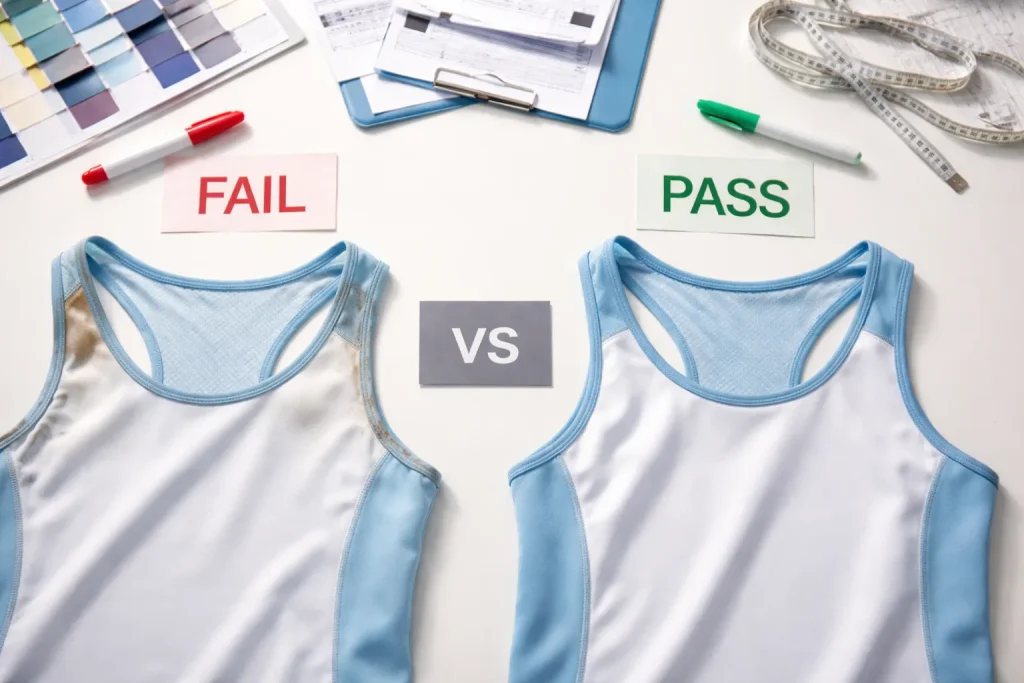
Mistake #2: Skipping Bulk Fabric Testing
One of the most expensive sourcing mistakes is approving production based only on appearance.
Important tests may include:
Performance Checklist
- Color fastness to washing
- Color fastness to perspiration
- Shrinkage testing
- Pilling resistance
- Stretch recovery
- UPF performance
- Chlorine resistance (for swimwear)
- Fabric weight verification (GSM)
Organizations such as OEKO-TEX and SGS provide testing standards widely recognized by international buyers.
Cost Impact
Skipping testing can result in:
- Product returns
- Retail complaints
- Brand reputation damage
- Reproduction costs
- Air freight replacement shipments
A fabric test costing a few hundred dollars may prevent losses worth thousands.
Mistake #3: Misunderstanding MOQ Requirements
MOQ is one of the most misunderstood areas in sportswear sourcing.
Many buyers assume:
“MOQ = total order quantity.”
In reality, factories often calculate MOQ based on:
- Style
- Color
- Fabric type
- Printing method
- Trim requirements
Example
A factory MOQ may be:
- 300 pcs per style
- 300 pcs per color
Not:
- 300 pcs total mixed across five colors
This misunderstanding frequently causes quotation revisions later.
Buyer Recommendation
Ask suppliers to clearly define:
- MOQ per style
- MOQ per color
- MOQ per fabric
- MOQ for custom labels
- MOQ for packaging
This prevents surprises after development begins.
Mistake #4: Ignoring Lead Time Risks
Many buyers focus on sewing time but underestimate other production stages.
Typical sportswear production timeline:
| Stage | Typical Duration |
| Tech Pack Review | 2-5 Days |
| Fabric Development | 7-20 Days |
| Sample Production | 7-15 Days |
| Sample Revisions | 5-15 Days |
| Bulk Material Procurement | 10-30 Days |
| Production | 20-45 Days |
| Inspection & Packing | 3-7 Days |
Late approval of:
- Colors
- Artwork
- Size sets
- Labels
- Packaging
often creates larger delays than manufacturing itself.
Mistake #5: Not Understanding Fabric Specifications
Many sourcing documents still contain vague descriptions such as:
- Premium quality fabric
- High quality material
- Performance fabric
These descriptions are not useful for production.
Buyers should specify measurable requirements.
Better Fabric Specifications
| Specification | Example |
| Composition | 75% Nylon / 25% Spandex |
| Weight | 220 GSM |
| Stretch | 4-Way Stretch |
| UV Protection | UPF 50+ |
| Shrinkage | Below 5% |
| Certification | GRS or OEKO-TEX |
| Construction | Interlock Knit |
Specific requirements reduce supplier interpretation errors.
Mistake #6: Skipping Size Validation
Sizing issues remain one of the leading causes of customer complaints.
Common risks include:
- Incorrect grading
- Market-specific fit differences
- Stretch calculation errors
- Pattern scaling mistakes
Sustainability Is Becoming a Purchasing Requirement
Recent industry reports from the Textile Exchange show continued growth in recycled fiber adoption across apparel supply chains.
Many buyers now request materials such as:
- GRS-certified recycled polyester
- REPREVE fibers
- ECONYL nylon
- OEKO-TEX certified fabrics
However, certification claims should always be verified through supporting documentation.
Not every recycled fabric automatically qualifies for certification-based sourcing programs.
How Experienced Buyers Reduce Import Risks
Successful buyers typically follow a structured sourcing process:
Step 1
Evaluate supplier capabilities rather than price alone.
Step 2
Review fabric specifications in detail.
Step 3
Develop and test samples thoroughly.
Step 4
Approve bulk fabric before production.
Step 5
Monitor production milestones.
Step 6
Conduct final inspections before shipment.
This process may appear slower initially but often reduces total project costs.
Need Help Evaluating Your Sportswear Production Plan?
Before placing a bulk order, buyers should review fabric specifications, MOQ structure, production timelines, testing requirements, and quality control checkpoints.
At Yunenx, we regularly help importers, established brands, wholesalers, sports clubs, and retail buyers identify sourcing risks before production begins. A clear development process often prevents costly corrections later.
You may also find these resources helpful:
- Sportswear Customs Requirements by Country: Buyer Guide
- How to Import Sportswear from China Successfully
- How to Audit a Sportswear Supplier Remotely: Buyer Checklist
- Custom Sportswear Manufacturing
Conclusion
Avoiding common sportswear importing mistakes starts with understanding that sportswear production is a technical process, not simply a purchasing transaction. Buyers who focus on supplier capability, fabric performance, testing procedures, MOQ clarity, and realistic lead times are far more likely to achieve successful outcomes.
The most reliable sourcing strategy is not finding the cheapest supplier. It is finding the right production partner who can consistently deliver products that meet your specifications, timeline, and business objectives.
FAQ
How can I verify whether a sportswear supplier is reliable?
Review production experience, factory audits, quality control procedures, testing capabilities, and communication responsiveness. Ask for recent production examples that match your product category rather than relying only on website claims.
What fabric information should be included in a tech pack?
A complete tech pack should include composition, GSM, construction type, stretch requirements, color standards, shrinkage tolerance, and any certification requirements such as OEKO-TEX or GRS.
Is a lower MOQ always better?
Not necessarily. Extremely low MOQ production often increases unit costs and may limit fabric options. Buyers should balance inventory risk against production efficiency and material availability.
Why do sportswear samples sometimes differ from bulk production?
Bulk fabrics may come from different dye lots, production batches, or suppliers. Without proper bulk fabric approval and testing, variations in color, stretch, and performance can occur.
How much lead time should buyers allow for sportswear imports?
Most custom sportswear projects require 45-90 days depending on fabric sourcing, sample revisions, production complexity, and shipping methods. Buyers should also include contingency time for approvals and testing.
References
- Textile Exchange Market Reports
- OEKO-TEX Standard 100
- SGS Textile Testing Services
- Global Recycled Standard (GRS)
- McKinsey (2025) Activewear Growth Report
Explore more insights here:
https://yunenx.com/blog/
About the Author
Yunenx Sportswear Team is a professional manufacturer specializing in custom sportswear, swimwear, and teamwear for established brands, importers, wholesalers, and retail programs worldwide.
We support buyers through every stage of the sourcing process — from product development and fabric selection to sampling, production, and bulk manufacturing — ensuring consistent quality and reliable delivery for long-term supply partnerships.
If you are sourcing a dependable sportswear or swimwear manufacturer for your next collection or seasonal program, our team is ready to support your product development and production needs.
Feel free to contact us for quotations, technical discussion, or sample evaluation.