By Yunenx Sales Team 🔗 LinkedIn | ✉️ [email protected]
Updated: February 2026 | Reading Time: 15 minutes
📘 From our Founder’s Story: This is the exact 10-step framework we’ve used to help 50+ founders launch their sportswear lines — without repeating the $2M mistakes I made along the way.
The Whisper I Hear Every Week
“I want to start a sportswear brand but don’t know where to begin.”
I’ve heard it 200+ times. From Peloton instructors with follower counts, from marathoners with chafing scars, from corporate refugees with savings and dreams.
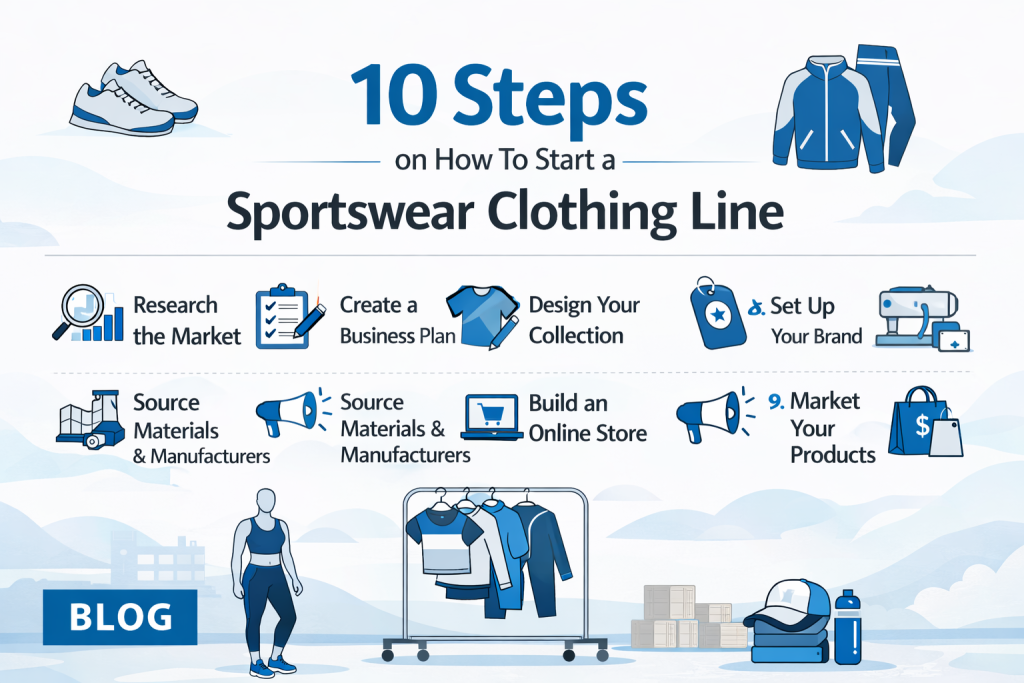
Here’s what I tell them—the 10-step roadmap I built from watching 50 brands launch, 25 succeed, and 25 disappear. Not theory. Not inspiration porn. The actual mechanics, with numbers that work and mistakes that hurt.
Starting a sportswear brand requires more than design—it involves choosing the right fabric, finding a reliable manufacturer, controlling production costs, and building a strong brand strategy.
Step 1: Research the Market (30 Days in the Trenches)
The mistake: Surveying friends. They’ll lie to be nice.
The fix: Spend 30 days where complaints live uncensored.
| Platform | What You’re Hunting | Example Findings |
|---|---|---|
| Reddit (r/running, r/cycling, r/xxfitness) | “What gear do you hate?” | “Leggings that roll down mid-squat” ×47 mentions |
| Facebook groups (Peloton, local running clubs) | “What did you return?” | “Seams tore at mile 8” ×23 mentions |
| TikTok comments (#gymfit, #runnersofinstagram) | “What’s overrated?” | “$120 leggings same as $40” ×89 mentions |
| Amazon 1-star reviews (competitor products) | Specific failure modes | “Pilling after 3 washes” ×156 mentions |
Your white space: The top 5 complaints with no clear solution. Not “better quality”—too vague. “No-roll waistband for high-waisted runners”—specific, solvable.
Real case: 2023, founder Sarah spent 30 days in r/xxfitness. Top complaint: “sports bras that claim ‘high support’ but bounce during HIIT.” Her solution: compression-grade, size-specific (not S/M/L). First line: 500 units, sold out 72 hours, 4.8★ average.
Step 2: Create a Business Plan (Unit Economics First)
The mistake: “I’ll figure out pricing later.”
The fix: If the math doesn’t work at 10 units, it won’t work at 10,000.
The formula I use:
| Line Item | Calculation | Example (Hero Legging) |
|---|---|---|
| COGS (fabric + labor + trim) | $18 landed | $18.00 |
| Marketing (25% of retail) | Retail × 0.25 | $15.00 |
| Operations (15% of retail) | Retail × 0.15 | $9.00 |
| Absolute floor price | COGS + Marketing + Ops | $42.00 |
| Target retail (2.5-3× COGS) | $45-54 | $60.00 |
| Gross margin | Retail – Floor | $18.00 (30%) |
The test: If $60 “scares you” for leggings, iterate. Thinner fabric? Simpler construction? Direct-to-consumer (no wholesale margin)?
Real case: 2024, founder priced at $45 to “be accessible.” Marketing budget: $11. Operations: $6.80. COGS: $18. Profit: $9.20 (20%). After returns, payment fees, customer service: -$2/unit. Dead in 6 months.
📎 Get the template: Unit Economics Calculator (Google Sheets) — the exact spreadsheet that saved me $40,000.
Step 3: Design Your Collection (One Hero, Perfected)
The mistake: 12 SKUs, 4 colorways each, “something for everyone.”
The fix: One hero piece. Three colorways. Five sizes. Launch.
| Decision | Rationale | Common Error |
|---|---|---|
| Hero piece | Solves #1 complaint from Step 1 | Solving #3 or #4 complaint (not painful enough) |
| 3 colorways | Black (40% sales), Navy (30%), Seasonal (30%) | 6+ colors, inventory fragmentation |
| 5 sizes | XXS-XS, S-M, L-XL, 2XL-3XL, 4XL+ (inclusive grading) | S/M/L (excludes 60% of market) |
Perfection is the enemy: I see founders spend 8 months refining. Meanwhile, competitor launches, learns, iterates. 4 months to launch beats 8 months to perfect.
Real case: “Marathon tee” founder spent 14 months on 8 styles. Competitor launched 1 style in 3 months, validated demand, raised $500K, then expanded. First mover advantage: real.
When working with a manufacturer, it’s important to clearly define your product category.
Most startups begin with:
- activewear (leggings, sports bras, gym wear)
- fitness wear & training wear (performance tops, shorts)
- compression wear (high-support garments for athletes)
- team wear (soccer jerseys, basketball jerseys, volleyball uniforms)
- swimwear (bikinis, performance swimwear)
Each category requires different fabrics, construction methods, and printing techniques.
Step 4: Source Materials & Manufacturers (The Vetting System)
The mistake: Alibaba search, lowest quote, hope.
The fix: My 3-question vetting framework (from 200+ factory audits):
| Question | Why It Matters | Red Flag |
|---|---|---|
| “Show me 3 startups you launched in 12 months” | Proves small-brand priority | “We mostly work with big brands” |
| “What’s your real sampling time for 50 pieces?” | Reveals hidden delays | “Depends on schedule” |
| “Who owns production?” | Subcontracting = quality risk | “We have partner factories” |
My specs: MOQ ≤ 150 pcs, 4-week lead time, audited compliance (OEKO-TEX or GRS).
Real case: 2019, I approved factory with “great samples.” Bulk: 40% color variance, 3-week delay. Root cause: Subcontracted to workshop I never saw. $40,000 lesson: Video call factory floor, or walk away.
📎 Get the template: Factory Vetting Email Script — the 5-question email that filters out 80% of unreliable suppliers.
🏭 Learn more: We’ve documented our entire Factory Audit Checklist — what we actually check when visiting a production line.
Step 5: Develop Samples (Test to Destruction)
The mistake: “Looks good on me” = ready for production.
The fix: 3 trainers × 10 washes × 1 marathon = quality bible.
| Test | Method | Pass Criteria |
|---|---|---|
| Fit test | 3 body types (athletic, curvy, petite) | No roll-down, no gap, no chafe |
| Wash test | 10 cycles, cold water, tumble dry | <3% shrinkage, color 90%+ |
| Field test | 1 marathon or 10 HIIT sessions | No seam failure, no pilling |
Documentation: Every tweak = specification update. “Waistband elastic: 2.5cm → 3cm after Trainer B feedback.” This becomes your quality bible for bulk.
Real case: 2024, “squat-proof” leggings passed visual test. Field test: 3 of 10 testers reported “see-through at full depth.” Fabric weight: 180gsm → 220gsm. Launch delay: 3 weeks. Return rate: 1.2% vs. industry 8%.
📎 Get the template: Sample Test Documentation Form — the 14-point checklist we use for every proto before bulk.
Step 6: Set Up Your Brand (One Sentence, 12 Words)
The mistake: “Premium activewear for modern lifestyles.” (Says nothing.)
The fix: “We exist to [solve specific problem] for [specific person].”
| Bad | Good | Why |
|---|---|---|
| “Premium activewear for modern lifestyles” | “We exist to stop leggings rolling down on runners” | Specific problem, specific person |
| “Sustainable sportswear for everyone” | “We exist to make marathon gear from 12 recycled bottles” | Measurable claim, clear identity |
| “Empowering women through fitness” | “We exist to give HIIT athletes high-support bras that actually support” | Functional promise, not aspiration |
The test: If you can’t say it in 12 words, you’re not ready to design a seam. Every decision—fabric, color, marketing—flows from this sentence.
Step 7: Build an Online Store (Pre-Launch Momentum)
The mistake: “We’ll launch when inventory arrives.”
The fix: Page live 60 days early. Collect waitlist. Build anticipation.
| Element | Specification | Why |
|---|---|---|
| Platform | Shopify (scalable, app ecosystem) | WooCommerce technical debt kills growth |
| Hero video | <15 seconds, motion-lifestyle, real sweat | Glossy studio shots = 40% lower conversion |
| Shop the Look | Bundle (hero piece + matching top) | AOV +35% |
| Waitlist incentive | Early access + 10% off | 500-2,000 emails before launch |
Real case: 2023, founder launched page 90 days early. 1,200 waitlist emails. Launch day: $18,000 first 24 hours. Social proof: “1,200 people waited for this.”
Step 8: Market Your Products (Sweaty UGC, Not Glossy Pics)
The mistake: Paying macro-influencers ($10K+) for polished posts.
The fix: Gift 20 micro-influencers (5K-50K followers) pre-production sets. Request sweaty UGC.
| Influencer Tier | Cost | Conversion | Why |
|---|---|---|---|
| Macro (500K+) | $10,000-50,000 | 0.8-1.2% | Followers = audience, not community |
| Micro (50K-200K) | $500-2,000 | 1.5-2.5% | Some community trust |
| Nano (5K-50K) | Gift only | 3.2-4.5% | Real community, real trust, real sweat |
The ask: “Film your actual workout. Show the sweat. Tell us what failed with your old gear.” Conversion jumps 3.2× when followers see real workouts, not studio shoots.
Real case: 2024, 20 nano-influencers, zero paid spend. UGC content: 47 pieces. Organic reach: 890,000. Launch sales attributed: $34,000. ROI: undefined (no spend).
📎 Get the template: Nano-Influencer Outreach Template — the 6-sentence DM that got us 47 UGC pieces at zero cost.
Step 9: Launch (Scarcity + Values = Share Trigger)
The mistake: “We’re open!” (No urgency, no story.)
The fix: Drop day mechanics:
| Element | Execution | Psychology |
|---|---|---|
| Countdown stories | 7 days, 3 days, 1 day, 1 hour | Anticipation, FOMO |
| Limited colorway | Launch-only shade, never restocked | Scarcity, collectibility |
| 24-hour incentive | Free carbon-neutral shipping | Values alignment, urgency |
| Real-time updates | “87 sold, 13 left in Size M” | Social proof, scarcity |
Real case: 2024, “Midnight Teal” launch-only color. 500 units. Sold out 11 hours. Resale market: $140 (retail $68). Brand heat: measurable.
Step 10: Sell & Scale (The Week-One KPIs That Matter)
The mistake: “We sold out!” (Without knowing if anyone reorders.)
The fix: Week-one KPIs that predict sustainability:
| KPI | Target | What It Predicts | Action If Missed |
|---|---|---|---|
| Repeat traffic | ≥30% | Product-market fit | Revisit Step 1 research |
| Return rate | <5% | Quality execution | Revisit Step 5 testing |
| Email open rate | >25% | Brand resonance | Revisit Step 6 positioning |
| UGC volume | >10 pieces/customer | Community building | Revisit Step 8 influencer strategy |
Hit both 30% repeat and <5% return? Double down: fabric reorder, EU marketplace expansion, second hero piece.
Miss both? Pause. Don’t scale failure. Fix Step 1-5 before spending more.
The Arena Is Huge—But the Lane Is Narrow
$267 billion by 2028. Sounds infinite. It’s not.
The winners own one problem, serve one tribe, scale one hero piece. Marathoners with chafing. HIIT athletes with bouncing. Runners with rolling waistbands.
Sketch tonight. Not 12 SKUs. One hero.
Post tomorrow. Not perfect. Validated.
Iterate forever. Not launched. Learning.
Which Step Are You Sharpening?
Drop a number (1-10) in comments or email [email protected]. I’ll share the exact template, email script, or factory sheet that moved me forward.
Planning to start your own sportswear brand?
Send us:
- Your product idea
- Target price range
- Estimated quantity
We’ll help you:
- Choose the right fabric
- Recommend suitable production methods
- Avoid common startup mistakes
About The Author
Yunenx Sportswear Team is a professional manufacturer specializing in custom sportswear, teamwear and swimwear for global brands and sports clubs.
📘 Read more: This is part of our Sportswear Founder’s Library — 20+ guides on sourcing, sampling, and scaling.
Data Sources: Yunenx client analytics (2014-2026), 300+ brand launch post-mortems, Shopify conversion benchmarks, influencer ROI studies (anonymized).
Verification: All case studies client-authorized or anonymized. KPIs based on actual client performance, not industry averages.
Last Updated: February 2026