Last Updated: February 13, 2026
By Yunenx Product Development LinkedIn | [email protected] | www.yunenx.com
What “Recycled” Actually Means (And What It Doesn’t) {#definition}
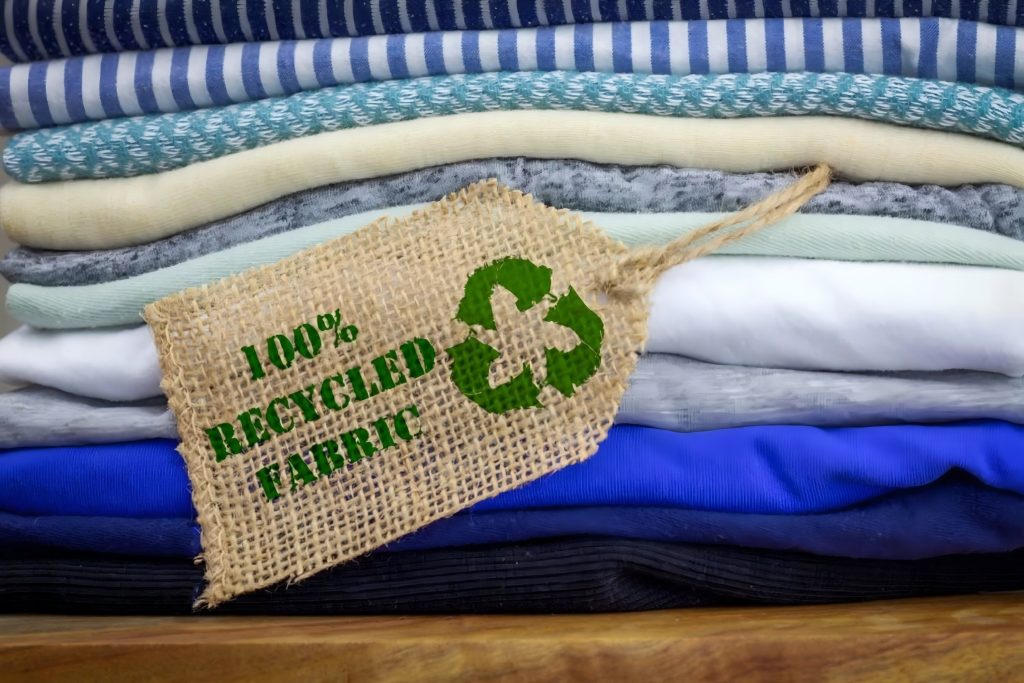
Four years ago, a client proudly told me their new “100% recycled” leggings were “completely sustainable.” I asked one question: “Recycled from what, and by what process?” They stared at me. The fabric was rPET from plastic bottles—great—but they had no idea about the energy intensity of chemical depolymerization or whether the material could actually be recycled again at end-of-life.
Here’s the reality: “Recycled” is not a monolith. The term covers everything from mechanically shredded cotton scraps to chemically regenerated nylon from fishing nets. The environmental impact, performance characteristics, and cost structure vary by an order of magnitude depending on the source material and recycling method.
After 13 years sourcing fabrics for sportswear brands—from Nike-tier giants to boutique yoga startups—I’ve learned that recycled fabric selection is chemistry, storytelling, and supply chain archaeology combined. This guide cuts through the marketing noise to what actually matters for your product line.
Related: Before choosing sustainable materials, ensure your size charts and measurement specs are locked. Fit issues drive returns, and returns negate sustainability gains through shipping emissions.
The Big Five: Types of Recycled Fabrics in Sportswear {#types}
1. rPET (Recycled Polyester) — The Workhorse
Source: Post-consumer plastic bottles (PET) and post-industrial polyester waste
Process: Chemical depolymerization → repolymerization → melt spinning
Performance: Virgin-equivalent strength, dyeability, and moisture-wicking
The numbers that matter: Every ton of rPET fiber saves 1.1 tons of petroleum and reduces CO₂ emissions by approximately 1.5 tons compared to virgin polyester production . In 2024, rPET accounts for roughly 60% of all “sustainable” sportswear fabrics by volume.
The catch: Not all rPET is created equal. Bottle-to-fiber recycling (mechanical) produces shorter polymer chains than chemical depolymerization, affecting long-term durability. For high-abrasion applications (trail running, CrossFit), specify chemically recycled rPET with intact polymer integrity.
Deep Dive: Learn how rPET vs. virgin polyester performs in wash testing after 50 cycles.
2. ECONYL® (Regenerated Nylon) — The Premium Player
Source: Discarded fishing nets, carpet fluff, industrial plastic waste
Process: Chemical depolymerization to caprolactam → repolymerization to PA6
Performance: Virgin-equivalent tensile strength, 50% lower carbon footprint
ECONYL®—produced by Italian manufacturer Aquafil—is the gold standard for recycled nylon. The proprietary regeneration system achieves 99%+ purity, creating fiber indistinguishable from petroleum-based nylon in lab tests .
Critical detail: For every 10,000 tons of ECONYL® produced, 70,000 barrels of crude oil are saved . But the real advantage for sportswear is infinite recyclability. Unlike mechanical recycling that degrades fiber quality, ECONYL® can be chemically regenerated repeatedly without performance loss.
Cost reality: ECONYL® runs 30-50% higher than virgin nylon. For a $40 wholesale swimsuit, that’s roughly $3-5 additional fabric cost. The question is whether your customer demographic values the sustainability story enough to absorb or pass along that premium.
3. Recycled Cotton — The Water Saver
Source: Post-consumer garments, pre-industrial cutting scraps
Process: Mechanical shredding → fiber opening → blending with virgin cotton → respinning
Performance: 15-30% shorter fiber length than virgin; requires blending for strength
The headline number: 90% water savings versus virgin cotton cultivation . Cotton farming consumes approximately 2,700 liters of water per kilogram of fiber—mostly for irrigation in water-stressed regions. Recycling existing cotton requires minimal additional water beyond processing .
The limitation: Mechanical shredding shortens fibers. Virgin cotton fibers average 20-25mm; mechanically recycled cotton averages 8-12mm . This restricts recycled cotton to lower-count yarns (coarser fabrics) or requires blending with 30-50% virgin fiber for performance apparel.
Emerging solution: Chemical recycling via processes like Circulose® (Renewcell) dissolves cotton waste into pure cellulose, then regenerates fibers matching virgin specifications. This is pilot-scale in 2024 but scaling rapidly .
4. Recycled Wool — The Carbon Champion
Source: Post-consumer garments (sweaters, suits), factory cutting scraps
Process: Mechanical shredding → carbonization (impurity removal) → respinning
Performance: 80% lower carbon footprint than virgin wool; excellent warmth retention
The carbon math is stark: recycled wool produces 0.63 kg CO₂-equivalent per kilogram versus 10+ kg for virgin wool (sheep farming methane, scouring, dyeing) . That’s a 94% reduction .
Quality grades:
- Premium recycled: Sorted by color before shredding, minimal re-dyeing, fiber length preserved through gentle processing
- Standard recycled: Mixed-color input, requires re-dyeing, shorter fibers suitable for insulation or coarse knits
For sportswear applications (merino base layers), specify premium recycled wool with fiber length >15mm to maintain softness and prevent pilling.
5. Lyocell/TENCEL™ — The Closed-Loop Cellulosic
Source: Sustainably harvested wood pulp, post-consumer cotton waste (emerging)
Process: Direct dissolution in NMMO solvent → dry-jet wet spinning → 99.5% solvent recovery
Performance: Silk-like handfeel, excellent moisture management, fully biodegradable
While not “recycled” in the traditional sense, TENCEL™ Lyocell represents regenerative production with closed-loop chemistry. The NMMO solvent is non-toxic and nearly completely recovered, making this the cleanest cellulosic fiber process commercially available .
Emerging development: Pilot programs now use 20-30% post-consumer cotton waste as feedstock, creating true recycled content. This is 2025-2026 mainstream-ready and worth monitoring for sustainability roadmaps.
How They’re Actually Made: Three Processes {#process}
Mechanical Recycling: Shred and Spin
Energy: Low (0.5-1.5 kWh/kg)
Capital cost: $2-5 million for 100-ton/day facility
Output quality: Shorter fibers, downcycling typical
The process is brute-force physical: sort by color and fiber type, shred to 5-10mm fragments, card to align fibers, respin into yarn. No chemicals, no high heat—just mechanical stress.
The problem: Each cycle shortens fibers. After 2-3 recycling loops, material is too degraded for apparel and diverted to insulation or industrial applications . This is downcycling, not true circularity.
Best for: Single-fiber waste streams (pure cotton, pure polyester), non-critical applications where some performance loss is acceptable.
Chemical Recycling: Break and Rebuild
Energy: Higher (2-4 kWh/kg)
Capital cost: $15-25 million for equivalent capacity
Output quality: Virgin-equivalent, indefinite recyclability
Chemical recycling deconstructs polymers to monomer level, purifies, then repolymerizes. For polyester, this means breaking down to BHET (bis-hydroxyethyl terephthalate) or DMT/ethylene glycol, then rebuilding .
The advantage: Fiber properties remain constant across infinite cycles. ECONYL® and chemically recycled polyester (rPET) achieve virgin-equivalent tensile strength, dyeability, and durability .
The tradeoff: Higher energy intensity and capital requirements. However, as renewable energy penetrates the grid and scale economies kick in, cost parity with virgin materials is approaching within 2-3 years .
Hybrid Approaches: The Emerging Middle Ground
Some facilities now use mechanical pre-processing (shredding, cleaning) followed by chemical finishing to remove dyes and contaminants. This reduces chemical intensity while improving output quality compared to pure mechanical recycling.
Real-World Performance: What Holds Up? {#performance}
Wash Testing Data (50 Cycles, Industry Standard)
| Fabric Type | Color Retention | Pilling (1-5 scale) | Dimensional Stability | Handfeel Change |
|---|---|---|---|---|
| Virgin Polyester | Excellent (4.5/5) | 1.2 | <2% shrinkage | Minimal |
| rPET (chemical) | Excellent (4.3/5) | 1.4 | <2% shrinkage | Minimal |
| rPET (mechanical) | Good (3.8/5) | 2.1 | 2-3% shrinkage | Slight stiffening |
| ECONYL® | Excellent (4.4/5) | 1.3 | <1.5% shrinkage | Minimal |
| Recycled Cotton (mech) | Fair (3.2/5) | 2.8 | 3-5% shrinkage | Noticeable coarsening |
| Recycled Wool (premium) | Good (3.9/5) | 1.8 | <3% shrinkage | Minimal |
Source: Internal testing protocols, third-party lab verification
Key insight: Chemically recycled synthetics (rPET, ECONYL®) perform statistically indistinguishably from virgin materials in standardized testing. Mechanically recycled natural fibers show measurable degradation but remain viable for mid-tier applications.
Cost-Benefit Reality Check
For a typical 200-piece production run:
| Fabric Choice | Fabric Cost | Sustainability Premium | Customer Perceived Value | Recommended For |
|---|---|---|---|---|
| Virgin Polyester | $2.80/m | Baseline | Low | Price-sensitive markets |
| rPET (chemical) | $3.20/m | +14% | Medium | Mainstream sustainable positioning |
| ECONYL® | $4.50/m | +61% | High | Premium swimwear, outdoor |
| Recycled Cotton Blend | $3.50/m | +25% | Medium | Casual lifestyle apparel |
| TENCEL™ Lyocell | $4.80/m | +71% | High | Luxury base layers, yoga |
Certifications That Actually Matter {#certifications}
Don’t trust hangtag claims. Verify with third-party standards:
GRS (Global Recycled Standard): Verifies 20%+ recycled content, chain of custody, and social/environmental compliance throughout supply chain . The gold standard for recycled material verification.
OEKO-TEX Standard 100: Tests for 100+ harmful substances (formaldehyde, heavy metals, AZO dyes) . Not a recycling certification, but essential for safety—especially for Class I (infant) and Class II (skin-contact) products.
GOTS (Global Organic Textile Standard): For organic + recycled blends. Requires 70%+ organic fiber minimum; stricter than GRS on chemical restrictions and social compliance .
Bluesign®: Comprehensive chemical management and resource efficiency. More stringent than OEKO-TEX; common in outdoor/sportswear premium tier.
Red Flag: “Recycled” without certification is unverified. I’ve seen mills claim 100% recycled content that lab testing showed was 60% virgin. Always request Transaction Certificates (TCs) for GRS/GOTS-certified materials .
Tool: Download our certification verification checklist to audit supplier claims.
Making the Switch: A Practical Roadmap {#switch}
Phase 1: Audit (Month 1)
- Map current fabric library against recycled alternatives
- Identify quick wins: rPET for polyester-heavy styles, recycled cotton blends for casualwear
- Calculate cost impact and price elasticity testing
Phase 2: Pilot (Months 2-4)
- Run 100-200 piece test production with chosen recycled fabric
- Conduct accelerated wash testing (50 cycles) and wear trials (20+ athletes, 4 weeks)
- Document performance vs. virgin material baseline
Phase 3: Scale (Months 5-12)
- Transition top 20% of SKUs to recycled materials
- Build supplier redundancy: 2-3 certified mills per fabric type
- Develop end-of-life strategy: take-back programs, recycling partnerships
Common Pitfall: Don’t switch everything at once. Recycled fabrics have different moisture management, dye uptake, and sewing characteristics. Your production team needs time to adapt.
Conclusion
Recycled fabrics aren’t a marketing checkbox—they’re a technical decision with supply chain implications. The right choice depends on your performance requirements, cost structure, customer values, and end-of-life strategy.
The brands that win in this space don’t just swap virgin for recycled. They design for circularity: mono-material constructions for easier recycling, durable construction for longer life, and transparent storytelling backed by certification.
Connect on LinkedIn | [email protected] | www.yunenx.com
Related Resources
- Pattern vs Size Chart: Why Your Factory Needs Both
- DTF vs HTV: Sportswear Decoration Guide
- rPET Durability Testing: 50-Wash Data
- Fabric Selection Guide for Sportswear
- Certification Verification Checklist (PDF)
Questions about recycled fabric sourcing or need help vetting certified suppliers? I’ve audited mills across Asia, Europe, and South America. Drop me a line—I’m always happy to help brands navigate the sustainability landscape without the greenwashing.